Showing posts with label writing. Show all posts

Sunday, November 23, 2014

Dear Jxxxxxxn

I've heard a lot about how it can be cathartic to write a letter to someone that you'll never be able to speak to, and so I decided to write this. It felt incredibly good to get all of this out, even with it being this many years later. So here it is:

------

Dear Jxxxxxxn,

I don't know why I'm writing this letter.

I don't know what I can say to you, eight years later, that would bring me any more closure than what I had to find by myself. Because you never looked me in the eye and said it was done. Never saw my face and the tears streaming down my cheeks. Your message of finality was sent to me online, or in half-eaten phone calls at random hours of the day and night. 

It was in the box that you left outside my apartment building at seven a.m. one day, along with the monogrammed journal I'd gotten you for your birthday.

I could tell you that things have gotten much better since I last saw you. The broken girl, the shell you left behind has filled back in and is complete again. Complete not because I know I'm okay even though you're not here, but because I know I was okay even when you were there.  You don't make me more or less. I am better not because you are gone, but because I  have finally arrived.

I remember you messaging me once, months after everything happened, to tell me that you were sorry for ruining my life. 

I was as angered by it then as I am at peace with it now. You don't owe me any apology, silly, because you didn't ruin my life. In fact, it's because of you that I know what being in love feels like. I know now that you didn't feel that way about me, but it does not make what I felt any less real. 

I loved you very much, you see. It surprised me how much I did, because I had no idea I could feel that deeply for someone. I thought being on the autism spectrum meant that I would never fall in love, but you proved me wrong. I learned that I could give my whole heart to someone, that I could feel tingly and slightly nauseated (in a good way) at just the thought of seeing someone, all at once. I learned that I could lose myself in love and find my way back, no matter how long or hard I fell.

In the end, you tore my heart out and stomped on it. As high as the high of being in love was, the low of losing it was the lowest I've ever gone. I felt everything and nothing at the same time, a pain so profound it just bled into numbness. Sometimes I still wonder if any of it was real, for you. If you ever actually felt anything for me. But I don't need the truth from you anymore. It wouldn't matter even if you told it to me.

You didn't fall in love with me, Jxxxxxxn. But I think instead I got something a lot better, something that maybe wouldn't have happened without you.

I fell in love with me. 

And I'm still standing.

Sincerely yours,

~*Amy Gravino

Monday, September 29, 2014

The Butterfly and the Bear

Once upon a time, there was a butterfly and a bear.

They became friends when they were little, fast frends, because the bear didn’t get along with the other bears and the butterfly didn’t get along with the other butterflies. They met and became friends because they thought they were the same.

The butterfly and the bear stayed friends for many happy years, fluttering/walking side by side (respectively). Despite their differences, no one could tell them that they weren’t alike. The butterfly thought, The bear is an animal, and I’m an animal. We’re both animals!

Over time, the bear grew bigger, and the butterfly did, too. The bigger they got, though, the more the butterfly noticed how big the bear’s shadow was. The bear made long strides with its four feet, moving faster than the butterfly could keep up with, even though it flapped its wings as hard as it could.

Most frightening of all was when the bear began to stand on its two hind legs and roared in the butterfly’s tiny face. The butterfly had never heard the bear make such a sound before, not in all the time they’d been friends, and a new, very strange thought came into the butterfly’s head:

Maybe the bear and I are different…

Such thoughts unnerved the butterfly, and it quickly shook them off and flew back to the bear, hoping that if it reminded the bear they were friends, the bear would stop roaring.

The only thing the bear did was roar some more.

Soon the butterfly could not take the bear’s roaring, so loud and chilling that the butterfly saw the bear not as its friend, but as something that could hurt it. And that made it all the worse—knowing that the bear could hurt the butterfly and not care if it did. Worse, even, than the bear actually hurting it.

Eventually, the butterfly stopped seeing the bear, as it hid deep in its dark cave, eschewing sunlight and the butterfly’s company in favor of a solitary, cold existence. The butterfly sought out other butterflies—some blue with white spots, some orange with patches of black, and even some yellow ones. Suddenly the butterfly felt alive, more at ease, and loved, things it had never felt before. The other butterflies flapped happily whenever the butterfly came near, so unlike the fearsome roar of the butterfly’s old friend.

…But the butterfly could not forget the bear entirely.

It was late the day the butterfly saw the bear one last time. Streaks of pink and purple-y blue lined the horizon, a cloudless backdrop so fitting for a moment of clarity.

The bear invited the butterfly into its cave, and the butterfly reluctantly accepted. It did not know what to expect—Had the bear learned to stop roaring? Did it remember when it and the butterfly were friends? Questions to which the butterfly had so longed for answers, and that it now hoped to get.

Slowly, the butterfly flew into the cave, peering into the darkness for any sign of the bear. The further inside the butterfly went, the more the light dimmed. The smell inside the cave was like decay, as if the life inside had all but disappeared. And finally, after flapping all the way to the back of the cave, the butterfly found the bear, and was horrified by what it saw.

The bear’s once-soft fur was matted, covered in dirt and dust. Its strong legs were splayed apart and immobile, as if the bear had stopped walking after its and the butterfly parted ways. And the bear’s eyes, previously warm and gentle, had grown cold and distant, fully devoid of their long-lost sparkle.

Before the butterfly could even ask the bear what had happened, it lifted one still-working limb and swiped at the butterfly, its razor-sharp claws tearing, and it missed the butterfly’s heart by only the barest inch.

The now-wounded butterfly turned from the bear and flew from the cave—as much as a wounded butterfly can fly—and did not stop until it reached the cool night air. Relief coursed through the butterfly’s veins, and it finally came to rest on a tree branch nearby.

The bear is not my friend anymore.

Relief. Sadness. Despair. The butterfly knew them all in that moment, unable to stop the tiny tears springing from its eyes. It thought of what the bear once was, compared to what it had become, and knew the only thing left was to return to the other butterflies and leave the bear behind.

The butterfly needs time to heal. The scars won’t ever fully fade away.

The butterfly has come out from under the bear’s shadow.

The butterfly is free.

Saturday, January 21, 2012

Cinnamon Stick.

That sweet-smelling spice that stirs into the froth.

I remember when my hair was down to my waist. It was when I smelled cinnamon in my grandmother’s house, the air rife with it at Christmas with gingerbread men baking in the oven.

The pajamas are scratchy, all heavy and cuffed, with a long zipper running up the front. The bottoms of the feet are padded, whispering under me as I walk from room to room.

The tree is blue. Ribbons, ornaments, white lights strung elegantly from top to bottom. The angel is on top. Everything is breathing, and the plastic on the table squeaks under my fingers. Plates of red, yellow, olive green pass through my mind, eyes flying open as the grainy crunch of warm bread fills my mouth.

I never ate much. It was always about the presents, the tearing, the ripping, the grabbing, the heart leaped up hard in the back of your throat, stomach gurgling with anticipation. Yet whatever lived inside those ornately wrapped packages is a mystery to me. I just see her face, pink lipsticked lips, short brown hair. And her smile. A grandmother’s protecting smile.

The pieces lie fragmented—sharp shards tossed askew on the open plain of my memory. I keep trying to put them back together. To reassemble that place, that last refuge of a lonely child. Where I was safe.

Where I wasn’t where I am now, which is the last place safe can ever be.

Sometimes, It Helps When I Write

It’s cold. My right hand more than my left is full of chill, and the soles of my feet. A fluffy robe is no match for winter’s aim. No matter how much I try to get warm, it stays the same. I’m running out of time, running out of air, of breath and wind and socks and pleated skirts that fall over your thighs just so.

Milk feeds me, with a plate of warmed cookies for eating. My worn knuckles bend and crack slightly as I grip the glass, trying to hold on. That’s all I’ve been doing—trying to hold on. Where they can’t get me. Here, I thought I was safe. Here, away from blues and purples and those uncomfortable chairs that make your back ache.

I’m getting this out. Out, out damned spot and stripe and zig-zag, zig-zags on zebras who live behind their own set of bars and hooves clawing into the dirt. Their skin must be so soft, covered in coarse hairs. So are we, but we shave ours off. That’s why we’re naked.

Blood is the color of my fragrant sun, shining heavy and heated above burning the skin of my face, even in the coldest days. I’m not waiting to fall apart, not holding my breath, cheeks puffing bigger and bigger, not for them, not ever. I breathe. I live. For me.

For a future that doesn’t have them written in it.

That’s where I am going.

Monday, October 17, 2011

October Update: New Office, ANJ Conference, and More

It's been just about a month since my last entry, and I have much to report! Having now completed my Masters degree in Applied Behavior Analysis, I am turning to the business of being employed. I needed an office space for A.S.C.O.T. Coaching, my Asperger's college coaching business, and was fortunate enough to be offered one a few months ago. My friend/colleague Nicole has her own business as well (for working with individuals with special needs), so we talked it over and decided to share this office and use it for each of our respective business needs.

Well, we got the keys at the beginning of September, and have spent the last month moving in and trying to get everything up and running. Now that we have a computer, bookcase, lamps, our respective degrees hanging on the wall, and all sorts of miscellaneous office equipment, I finally feel ready to be open for business. I hope to have an office-warming party soon, to formally welcome everyone and get the word out about the office.

Publication-wise, an article that I wrote--"I’m Gonna Let It Shine: How This Little Light Grew Into a Fiery Self-Advocate"--was just published in the Fall 2011 issue of AHA-NY's "On the Spectrum" newsletter. In addition, my mom wrote a short piece about my appearing at the United Nations earlier this year, and it was also published in this newsletter. Woo!

Last week, I went down to Atlantic City for Autism New Jersey's annual conference. I was asked a few months ago to speak on the self-advocate panel, along with two other adults on the spectrum, and I agreed to do so. For past conferences, I have tended to write notes on index cards to refer to, rather than fully writing out my speech. This time, however, I decided to go ahead and write it out.

Unfortunately, the panel was not videotaped, but I thought some folks might be interested to read my speech, so I'm posting it here on my blog. It's in .pdf format, so just click HERE to read it.

Also, I recently received a phone call, on my land line, with an inquiry about the book I am working on, The Naughty Autie. The caller said he belonged to an Asperger's Syndrome support group at which I had been a guest speaker, and he wanted to know if the book was available for purchase in bookstores.

I was so amazed to have gotten a call like this, and I feel as though it is a sign from the universe: a sign to get my damn book published already! So, I'm now preparing to send my book proposal to a publisher that has expressed interest in it previously. We'll see what happens!

Finally, if you're in the New York City area, I will be performing a monologue on the second day of ARS SPECTRA, a salute to artists on the autism spectrum. The event runs from Thursday, October 27th to Sunday, October 30th, and is being held at the Soho Gallery for Digital Art, 138 Sullivan Street, New York, NY. Click HERE to view the public event invite on Facebook, which has many more details and info for ordering tickets. Hope to see you there!

Sunday, September 11, 2011

Remembering September 11th

I swore I wouldn’t be one of the many people contributing to the flood of “9/11” posts today, but the memories that I have are too strong. I promise I will be brief.

It was my freshman year of college. I was in my American Civilization class that morning, lamenting the ungodly early, ignorant to how deeply irony was working overtime that day.

My professor was Mr. Fedrick, a man who bore more than a passing resemblance to Bilbo Baggins. Another professor interrupted the lesson, and he stepped into the hall to speak with him. He came back a few moments later, blue eyes now glassy and downcast. He held his hands in front of him, clutching his glasses, and gravely informed us of what had happened.

Class was immediately dismissed. Dazed, frightened, and still not entirely sure of what was going on, I returned to my dorm. The elevators opened, and I saw that the floor was deserted. The silence was deafening, save for the televisions in the lounge. The doors were open wide, and several students were standing near the TVs, where the news blared loudly. We were all grief-stricken, more so as each new moment of horror unfolded in front of us.

Smoke, flame, ash. Bodies falling. Dust to dust.

My parents were on Long Island, not near the city. Still, I thought of them, and ran for the phone in my room. But I could not get through—the lines were jammed. Cut off from the people I loved—from safety, from reassurance, from calm—my chest clenched. Yet this was only the barest taste of the agony that others felt that day, and have felt every day since.

Ten years later, I still remember. Ten years later, and I will never forget.

R.I.P. to all of the victims of September 11th, in NYC, the Pentagon, Pennsylvania, and everywhere else; and to the firefighters, police, and emergency personnel who went into those towers and never came out. And a special nod to my uncle, who actually was employed in one of the towers, but wasn’t feeling well and didn’t go into work that day.

Tuesday, March 29, 2011

Autism Speaks "Light It Up Blue" Blog Post

I was recently asked to write a blog post for Autism Speaks' specially created "Light It Up Blue" blog dedicated to letters addressed to the President to get the White House to participate in this campaign on April 2nd, World Autism Awareness Day.

This post was originally published on the Light It Up Blue blog here.

~*~

"Dear Mr. President and First Lady Michelle Obama,

Every year, the same day comes. Crunch! go the crisp leaves under your feet, twirling around in the cool, late autumn breeze, before coming to land on the earth below. Children race from house to house, their sneaker-covered feet thumping across the pavement, waiting for the door to open, to see the face of whoever lives there, voices ringing out in a choir of “Trick or treat!” when the moment finally arrives.

I am, of course, talking about Halloween: the time of ghosts, goblins, bobbing apples, and mini-sized candies filling up plastic buckets across the nation. And with the spirit of frivolity and mischievous fun also comes words of caution, issued forth by parents far and wide. From elementary school onward, every kid knew the most important Halloween rule of all: Never go to a house that doesn’t have any lights on.

A light is a symbol of welcome. Come, the light says. This is a safe place. For centuries, a lantern hanging outside of a building meant hospitality, and a darkened establishment meant emptiness—a place to be avoided. Today, we still have lights on the front of our houses, and when we know company is coming, it is often custom to leave the light on.

For individuals with autism spectrum disorders, however, the houses we encounter—be they school, a disability service center, even the place we supposedly call home—are often dark. We have been outcast, shunned, bullied, pushed around by a system that itself sits in darkness. There is no welcome for us, Mr. President. Time and again, we look for the light on the front of the house, and it is nowhere to be found.

Too often, people on the autism spectrum spend their entire lives in these dark houses. We have met rejection even at the hands of our own families, whose inability to understand our diagnosis and who we are leads to prolonged emotional and social isolation—a painful reminder of how much we don’t fit in, even with those whose blood we share.

And yet, with our honesty, loyalty, and compassionate natures, the houses we build as adults stay lit. We grow up; we find our way in this world that is not built for people like us, persevering, and despite the pain we have felt and the heartaches we have suffered, we let others in, not wanting them to face the same dark houses in which we once lived.

It is for these reasons and so many others, Mr. President and First Lady Michelle, that I am asking you to light the White House blue on April 2nd this year, in honor of World Autism Awareness Day. Our voices have typically not been those that are heard in the arena of politics, but with a single action, this can change . By taking part in this campaign, you will bring hope and encouragement to countless individuals on the autism spectrum and their loved ones. Stand with the autism community, and let your commitment to our cause shine bright.

Let your house be one with the lights on."

- Amy Gravino
Self-Advocate, Writer, Asperger's Syndrome College Coach

Sunday, January 2, 2011

An Ode to 2010

It is now a new year. The old has passed beneath our feet, and as we embrace this new beginning, I thought I would take a look back at what has ended. The ups, the downs, the highs, and the lows--there were many that took place this past year, and I have encapsulated them all in this piece.

So, without further ado, this is Ode to 2010:

---

On a quiet, moon's sliver of a street
Did we and 2010 first meet
And if we'd known what was to come as we dined on chili and trifle
The calendar hanging we would have aimed, and shot it with a rifle.

Through the winter months' long chill
Different seats in different concert halls were filled
From Y to A in revered North
To gardens grey at thirteenth and fourth.

The final stage of study came
Demands three years of grad school could not tame
Not one, but two thesis defenses
Whose madness robbed me of my good senses.

Eyes gazed upon freckled shoulders, in weather good and bad
Fickle fortune intervened; an accident was had.
While mechanics murmured, poked and prodded under the hood
True blue friends comforted, kept company, and stood.

Longstanding friendships fell from sight
To keep them I fought, with all of my might
Twelve years cast off, with nary a word
Heartbreaking silence the only sound heard.

No relationship did find me hence
No talk of romance, nor white picket fence
Cupid debated, but when push came to shove
I remained alone, and watched others fall in love.

Positives were had, to be quite sure
Published writing, public speaking, new culinary dishes galore
And the greatest accomplishment: a new LLC
A business for coaching college students, just like me

In 2010, a great many things were lost
And compared to what was given, was it worth the cost?
I do not know, nor perhaps will I ever
How time can be so cruel, so kind, or so clever

I'm ready to say goodbye to this lopsided year
To abandon the grief, the doubt, and the fear
So, like the Jews, whose bread stays unleavened
I declare, "Shalom! Good riddance, 2010! And hello and welcome to 2011!"

Monday, November 15, 2010

Hair of the Dog

Every November, an event called NaNoWriMo takes place. It's where people challenge themselves to write a novel in exactly one month. I tried to do it last year (unsuccessfully), and though I'm not taking part this time around, (much as I would have liked to), I've been thinking a lot lately about a situation that occurred recently with an old friend of mine who stopped talking to me a few months ago.

I wanted to find some way of dealing with the situation, to sort through all of the emotions I've been feeling, so I decided to write about a particular memory I have of her. I have no idea if this is any good, but now I know I can write 850-ish words in an hour (that's how long it took me to write this), so I feel much more motivated to work on my book.

This piece is called Hair of the Dog.

---

"Come on, Charley!"

Her voice is sing-song, playful as she waves her hand. He pants happily, eyes bright and shining, chest heaving with eager breath, and trots over. I watch as she clips the green leash to his collar, readying him.

"Wanna go for a walk?"

He barks in the affirmative, tail wagging nonstop. The noise rings in my ears, but I stay calm, focused on the task at hand. I pull on my coat, following her copper ponytail out into the cool, autumn night.

Down the road, Charley does his business, and she lets him off the leash soon after. "So he can run around a little," she says, and I nod.

The lights from the baseball field behind her street cast a faint glow; beams of light slipping in between the thick trees. It's only steps to the high school from there, beige and black walls and doors that close with a thunderous click.

Charley's vibrating form appears under the streetlight then, thick, white curls turned to an unnatural orange. A rustling in the bushes catches his attention, and he's off, chasing the unlucky--and no doubt unhappy--neighborhood cat.

We shake our heads in disbelief, our collective laughter echoing down the street.

---

She calls him back soon after, and we head inside, clomping up the creaking steps and through the two doors into the foyer. The smell of dog hits me in the face almost immediately, and I wrinkle my nose in disgust.

I'm not a dog person.

It's always the barking, the piercing volume that vibrates inside my skull and leaves me trembling, overwhelmed. The yappy dogs are the worst, with their high-pitched yelps and jumping as if they have springs attached to their paws. The combination of the two is enough to send me running from the room.

She told me how dumb Charley was when I first met him. That he'd never hurt a fly. I remember the almost permanent grin he had on his face, teeth exposed, pink tongue hanging down as he stared at us. His fur reminds me of my mother's sweater--coarse and smooth, bristling underneath and between my fingers.

He's helped me be not afraid.

I walk behind her to the TV room, listening to the scritch-scratch of his feet on the hardwood floor. It had been the usual back-and-forth at the video store that night, trying to decide what to rent. We never agree on anything, until the very last moment, when some movie we'd missed catches both our attention.

"Are you okay with this one?"

"I am if you are."

"I'm good."

I watch the tape slide into the VCR, the television flickering as the FBI warning appeared on screen. She grabs the remote then--one of several on the ruddy wooden chest in front of us--and fast-forwards. Her legs are tucked under her, a bowl of popcorn curled in one hand and pressed against her sweatshirt-covered torso. My purchase from the store was a box of gummi bears, and I've already taken them out of the package and sorted them by color, discarding the oranges and yellows.

She's washed her makeup off, revealing the truth behind the facade. Erect, reddened pimples dot the landscape of her face, all connecting to form a picture of what is inside. I've watched her hide, standing in front of the mirror, concealing, pressing the brush with fevered strokes, again and again. I don't understand it.

To me, she is beautiful. She is my best friend, and she is beautiful. If I can see it, why can't she?

The movie begins to play, but I'm regarding her silently now, honored by this moment. She has let me know who she really is. I do the same thing, but all the time, because I don't know how to hide. Sitting here beside her, eating painstakingly arranged gummi bears, I can finally breathe. I am at peace.

She's a part of me. A string for this kite that is always flying, flying, nearly flying away forever. She makes the earth real. And when I'm with her, I'm real.

Charley is lying next to her on the couch now, head bowed and resting on her leg. His doggy derrière is perilously close to my person, and so I hurriedly scoot over, one eye fixed warily on his posterior. She seems even calmer when he is around, and I gaze at the two of them, grateful for the comfort they have both given me.

The movie has finished, a final swell of music crescendoing as the credits start to roll. This is the part I dread, the knowing it's begun to end. I would like to live in a universe of infinite Saturday nights, spent exactly like this. There would never be any Sundays. Sunday is the falling day, the day of knowing what's coming, and being able to do nothing about it, except wait.

But I am safe here, in the night. Behind these walls, in this room, on this couch. With her sitting next to me. I'm sixteen, and she's my best friend, and she always will be.

...Won't she?

Saturday, July 31, 2010

Home Is Where the Hard Is

Sitting on an enclosed deck in the middle of a thunderstorm has become a favorite pastime of mine. I used to be terrified of thunder; as a child, even the slightest rumble would send me flying under the covers, shaking with fear. Even now, the storms seem scarier when I am inside, so I call upon my father to join me, where we settle into the green and white-striped chairs--his, always the recliner. With the sounds of whipping wind and falling rain all around me, I am calm.

My parents still live in the house I grew up in, about a two hour's drive from where I am now in New Jersey. Graduate school has kept me almost absurdly busy, and I don't go back there very often, except for the occasional orthodontist appointment or holiday.

There is a danger in visiting one's old hometown, in that you run the risk of seeing people you know. People from the past, who remind you of the person you used to be, and who you spent years trying to forget.

People you went to high school with.

The beige and black building is much smaller than I remember. At its feet rests a verdant landscape, the grassy, crater-shaped bowl used for baseball in summer and sledding in the winter. A long handrail in the middle of half moon-shaped steps leads the way to the front doors, whose once heavy handles yield easily to my hand. From faraway glance, it is peaceful, serene, and immaculately kept.

For me, it is and was my vale of tears.

It can be said that people spend most of their lives trying to figure out who they are. It can also be said that this process almost universally begins in high school. Jock. Nerd. Homecoming queen. Band geek. Class president. Loner. Which one are you? Now's the time to find out, to find others like you and stand together--allies in the silent war of the hallways.

But to do that, you first must know that you are a person. I never got that far.

Sometimes it was only a look. A brow furrowing in disapproval, eyes rolling almost comically far up into their heads, a brief scoff before finally turning away. I never knew what these things meant, but still I was left with a deep burning inside my heart. Chest heaving, cheeks flushed, the beginnings of teardrops forming in my throat. A powerful poison that was slowly, methodically, killing me.

I knew I wasn't like my peers. Not popular, beautiful, happy. Not normal. Through elementary and middle school, my apartness from them became painfully obvious in almost every way, but it wasn't until high school that I realized the true nature of the divide between us.

They were human. I wasn't.

I believed this. At first, it was because they told me. "Psycho. Freak. Loser. Retard." In between classes, alone in the hall, standing by myself not saying a word. If there was an opportunity, they took it, hurling insults like tommy gun-loaded paper airplanes whizzing through the air.

Am I someone? Am I even alive? the questions plagued my thoughts. After a while it became impossible to see the difference between their lie and my truth. Their words were pinballs, firing around in my mind through the maze of neurons and synapses, reverberating, shrieking as they traipsed and ran and looked for the end of the labyrinth, to no avail.

I was convinced that I wasn't really there; just a body, floating through those halls day after day, with no essence or tangibleness behind it. Nothing to tether me to the earth, to the rest of humanity. My soul belonged to them.

This was the storm that I lived in, with no shelter to run to, no protection to shield me. No matter where I tried to hide, the thunder always found me. And it roared.

My father gently rocks back and forth in his recliner, the screws squeaking quietly as I listen. The rain is beginning to subside now, the sky brightening, and the air is tinged with a crisp coolness. The trees are stained, their leaves heavy with damp. Tiny droplets hang from every edge, pulling them down as if bowed. Another survivor. I nod my head gently in reply. We have both made it through the storm.

Monday, April 19, 2010

Exciting News

I have something wonderful to share with you all, though I'm beginning to feel like a bit of a broken record! But it definitely deserves to be mentioned on my blog, so here goes.

As I recounted in a previous entry, back at the end of February, I participated in a Think Tank at Autism Speaks' headquarters in NYC. The purpose of this was to discuss the result of the Community Life section of the AFAA Town Hall meeting that took place in October.

While I was at the headquarters of AS, I briefly met a man named Marc Sirkin, the Chief Community Officer. He e-mailed me shortly thereafter, saying he'd looked at my blog and wanted to post my "Letter To My Younger Self" to Autism Speaks' main blog.

All I could think of was what a great opportunity it would be to really reach and (hopefully) help a wide range of people, so I said yes. After a couple weeks of waiting, it was finally posted up on Thursday. You can see it here: http://blog.autismspeaks.org/2010/04/15/itow-gravino/

A link was also posted on Autism Speaks' Facebook page, here: http://www.facebook.com/autismspeaks?ref=ts#!/posted.php?id=75219157496&share_id=118852414795530&comments=1#s118852414795530.

The response has been absolutely unbelievable. As of now, I've received 47 comments on it, and it's received over 200 "likes" on the Facebook page and there are 69 comments so far there. The comments have been incredible, more than anything I ever would have expected. I was moved to tears by some of the things people said, and I'm so grateful that I did take this opportunity.

I also found out yesterday that my post made Wordpress.com's list of Top Posts for April 17, 2010, coming in at #55: http://botd.wordpress.com/2010/04/17/top-posts-1448/.

It's becoming more apparent to me that there are two stages to this whole thing: the initial impact of when the blog was first posted, and now this rippling effect that seems to be taking place. Who knows what else may occur in the coming days, weeks, even months? I'm excited (and a little bit nervous) to find out.

To my new followers here on my blog and all of you who've come here by way of Autism Speaks: Welcome! I'm so happy to have you. I would just like to restate that I do make public speaking appearances at conferences, support group meetings, professional development workshops, school assemblies, and more, so if you are interested in having me speak to your group and read my "Letter to My Younger Self," please feel free to contact me via e-mail, or contact my business manager, Nicole Turon-Diaz, at learningbydesign@verizon.net. Thank you!

Thursday, August 27, 2009

Searching for Eve: A Review of the movie "Adam"

**WARNING: This review may contain slight spoilers. Read at your own discretion.

After months of build-up and tons of people asking me if I'd seen this movie, today I finally saw Adam, starring Hugh Dancy and Rose Byrne. I'm sure most everyone already knows the story, but it's about the life of a young man named Adam Raki who has Asperger's syndrome, and Beth Buchwald, the woman with whom he falls in love and has a relationship.

One thing that I had forearmed myself with as I went in to the film was not to get my hopes up about strongly "identifying" with the character of Adam. I belong to the listserv for GRASP, the Global and Regional Asperger Syndrome Partnership, and several people on the list have posted about seeing the movie and their feelings on it. The thing is, with maybe one exception, these people are all men. I knew today that what I was going to see was a depiction of the male version of Asperger's. Although there were several moments that resonated with me, as I expected, I did not completely identify with Adam.

That is not to say that the portrayal of a person with Asperger's syndrome was unfaithful or miscalculated. It was realistic, and it did capture some of the frustrations and pain I have experienced in my own life. But, again, this was still being told through a uniquely "male" lens. Now, it does make sense that a mainstream film (or almost mainstream, because I did see this at an art house theatre) featuring a titular character with Asperger's syndrome would be a man, because more males than females are diagnosed with the disorder. However, this does not mean that women on the spectrum aren't out there. They are, although many are misdiagnosed or not diagnosed at all, and I have hope that one day their stories will be told, too.

There was one scene in Adam that particularly struck me, which is where Adam discovers that Beth has lied to him about the circumstances surrounding his meeting her parents (he thought they ran into them coincidentally at a theatre for an off-Broadway show, but it was actually preplanned). Adam flew into a rage at this, calling Beth a "liar" and throwing things around the room. For one thing, I understand why he became so agitated--he thought Beth lying to him meant that she was pulling away from him and didn't care about him.

On the other, this was another "male" Aspie moment. The tantrum itself was a pure outburst--his emotions didn't even have time to flow through his body, they just came flying out at 100 miles per hour. I have had meltdowns in my life, but for me, what's happened is that the emotions have filled me completely and overwhelmed me to the point where they spilled out of me. Neither were my meltdowns directed at other people, as Adam's was (Beth later states that she was afraid he was going to hit her). The anger or frustration I felt in my younger years was directed mostly at myself, and I wouldn't have dreamed of hurting someone, and if it did happen (albeit unintentionally), I would be wracked with guilt.

This also speaks to the dichotomy of "male" versus "female" gender roles in society. For men, it's more permissible to have a "temper," to express rage in an outward fashion like that. Women, by contrast, are taught to contain their emotions, to behave and repress and act "ladylike." We see Adam throw this fit and feel sympathy for him; yet, I feel that if it were a woman acting similarly, the primary thought emanating from the audience would be, "What a crazy bitch!", and no sympathy would be given whatsoever.

The other issue concerning gender roles again comes from the onscreen individual with Asperger's being a male, and the love interest being a neurotypical (NT) female. Beth steps into Adam's world, reads the book "Pretending to be Normal" to learn more about AS, drills him to help him prepare for a job interview. Simply put, the idea put forward is that because she's a woman, it's "expected" that she would do these things for him. It may be a challenge at times and rather difficult, but it's never mentioned that there's any other possible route for her to take (i.e., not reading books, not making accommodations, expecting him to fit into her world). She, instead, takes measures to fit into his world.

Now, speaking from firsthand experience, I can tell you that I have yet to find an NT male who would do any of these things. I'm not saying that they're not out there, but I don't think there's any way a purely NT male would make these sort of accommodations for an Aspie female. In our society, women are supposed to be "nurturers," the "carers"...protecting and providing for everyone else. A man can be damaged or screwed up in all sorts of ways, yet all it takes is a woman to come along and "complete" him, to repair him. I do not think women have this luxury, but rather seem required to be put together, stable, and calm at all times. To put it bluntly: if I had a tantrum or meltdown like Adam did in the movie, the NT guy I was seeing or hoping to see would be out the door in seconds flat.

Again, I don't mean to seem like I'm not giving NT guys any credit. Heck, I currently live with one, and he's helped me in ways I can't even describe. But when it comes to a relationship, that's a whole other basket of eggs. Longevity is just not in the cards for a person like me. Indeed, in the movie, Adam and Beth do not end up together, which is representative of the romantic foibles of most real-life Aspies. But the fact that they courted and began dating so quickly also seems to be an anomaly. I know that this is part of the magic of the movies, but the fact is that Adam's "quirks" and "idiosyncrasies" were very endearing to Beth, and sadly this is not representative of real life. I myself have learned the hard way that certain qualities of my personality annoy or irritate more people than they enchant.

The other large issue that I felt was distorted was Adam's search for a job. When the movie starts, he has a job, but is soon fired due to a lack of productivity. He sends out something like 80 resumes or cover letters, and in what seems like no time at all, he hears from a company that doesn't think he's right for the job for which he applied, but they "have one that they think [he'd] be perfect for."

Employment is a huge struggle for people with Asperger's--both obtaining and keeping jobs. Upon Adam's termination, I felt the very same sting that I could tell he was feeling, numb and disoriented as he stumbled out of his office. His former co-workers attempted to offer sympathy, but he was too aggrieved to be receptive to such condolences. When he stepped outside, everything seemed louder, more jarring, moving him ever-closer to being totally overwhelmed. I experienced something quite similar when I was fired from my temp jobs in Seattle. They weren't even real jobs, like Adam's, but my heart was shattered when I was told to pack up and leave, and I remember just looking down at the floor as I made my way to the elevator, ashamed and upset.

But for Adam to bounce back so readily is, unfortunately, very atypical. The fact that he found a job through sending out online applications is also improbable, as many folks with AS go through organizations that look for employment for people with disabilities, or utilize other assistive services. The success rate of these is often low, and is even worse when these individuals look for jobs on their own. So, while I understand that the focus of this film was to be a romantic comedy, I do wish it would have delved more into the employment aspect. I was also confused by the fact that Adam became terribly agitated when a character suggested that he move out of his apartment, yet he seemed to readily embrace the idea of moving across the country to California for a job.The film was attempting to portray the difficulty with change and changes in routine that many individuals with AS have, so throwing in that latter plot point was one heck of a contradiction (to me, anyway).

So I'm sure you're all wondering, "All right, Amy, enough. Just tell me straight: Is Adam worth seeing?" My answer is yes. It does provide an NT viewer with a better understanding of Asperger's syndrome. For the Aspie viewer, it provides a fresh opportunity to identify with a character (which may have been much more of a challenge with the film Mozart and the Whale, which was based on the book of the same name and the lives of two real Aspies, Jerry and Mary Newport). Adam is truly a unique character, and it's much more possible for someone with Asperger's to say "Hey, that's like me!" because there are no preconceptions with which to contend.

Many AS folks may feel like Adam is showing or telling them things that they already know, but even I can't deny that I got a serious lump in my throat the first time the words "Asperger's syndrome" were uttered onscreen. In my entire life, I have never seen a character in a movie that I thought was really at all like me, and so this was a monumental step forward, both for cinema and for people with Asperger's syndrome everywhere. But I still hope to see a story from the female perspective make it to the silver screen one day, because it is the yin to this yang, the other side of this rare coin that we've finally been privileged to see. And it deserves a chance to shine.

Sunday, April 26, 2009

A Letter to My Younger Self

I recently received an e-mail from a reader of my blog, who wanted to know what sort of advice I could give to her 9-year-old daughter, who had recently been diagnosed with Asperger's syndrome. The e-mailer gave a very thoughtful suggestion, which was that I write a blog entry in the form of a letter to my younger self, which could then also serve as advice for current parents of children with AS.

I personally was not diagnosed until age 10, but I remember very clearly the loneliness, confusion, and frustration that come to define my life at that time, and how I had no one to turn to back then, no one who could tell me that it was going to be okay. A simple truth of pre-adolescence and teenagedom is that we never believe adults or anyone who tells us that everything is going to be all right. Not because of a lack of trust or innate cynicism (hey, it takes at least a few years to build up to that), but because it's just impossible to think that anyone could understand what we are going through. Well, I am someone who does know, and there are many things I would want to say to my younger self if I had the chance. I know that I can't save that girl, the younger me of long ago, but perhaps I can help a girl very much like that one right now. So, without further ado, here is my Letter to My Younger Self.

"Dear Amy,

I know you're feeling pretty bad right now. The other kids make fun of you a lot, and you don't know why. You're trying really hard to be friends with them--doing all of the things you think they want you to do, and it's just not working. But there is one thing you should know: It's not your fault. Other people might say that, and you won't be able to listen to them; but I am hoping that you will if it's coming from me. It's not your fault. Say it over and over in your head when you feel the worst, because that's when you'll need it most.

It's not your fault. How can it not be your fault? you'll say to yourself as the next few years go by. Everyone else can do this, can make friends, and be normal. Why can't you? That's just one of the many questions I know you have, questions you don't know how or are afraid to ask. They make you feel overwhelmed, like sitting in Mrs. St. Pierre's classroom every day, fidgeting nervously in your seat. You always get up during class to sharpen your pencil, and I know it's because you enjoy the smell when they're freshly-sharpened--it calms you down. So don't feel bad if the other kids snicker or laugh when you smell your pencil. They just don't understand.

You care a lot about what the other kids think of you. I know you hate going to Pool every week because you have to change in the locker room, and the girls make fun of your feet. This will cause you not to feel comfortable wearing flip-flops for many years, and you won't be okay with wearing them again until you're much older. It'll be like that with a lot of things people say to you in school--their exact words will fade from memory, but the effects they have on you will last a long time. But don't worry--one day you're going to make friends with someone who really loves your feet and will call your little toe, the one that didn't grow in right, your "Lucky Toe."

That's something you feel like you could use a lot of right now--luck. You keep hoping things will get better, but they never do. I have some good news, though; you won't lose that hope. No matter what happens, you'll still be optimistic--foolishly, maybe, but when you're older, people will tell you how wonderful it is that you are that way.

But I have to be honest with you: things are going to get a lot worse before they get better. You'll be in junior high school soon, and you don't know it, but seventh and eighth grades will be two of the worst years of your life. Once again: it's not your fault.

You like to look at things outside the window--the trees and blue sky make you feel calm. One day you will be in study hall, and you'll go right up to the window and stick your head out of it. That's when someone will tell you to jump. Other voices will join in, and even after the teacher finally tells everyone to be quiet and calms things down, you'll hear them in your head for a long time to come. Every day, someone will make you feel less. Not human. Unwanted. And you'll keep your head down and take it, because no one's going to tell you anything different.

But I will. You're not less, Amy. You're more. More because you have to work twice as hard as everyone else to make your voice heard. You don't know how to fight right now, except for when you lash out after not being able to handle the pain anymore, and then it's you who gets into trouble, rather than your tormentors. They know how not to be seen, to avoid detection. You don't. Even as an adult, you won't quite fully master the art of subtlety, but right now, you're bared to the world. Completely vulnerable. And your classmates are taking full advantage of that fact. They know how to hurt you in the worst ways, so they can get their jollies from your reactions. You can't understand what they're doing, and you just play straight into their hands, every time. Once more: It's not your fault.

These days, your classmates call you names--ugly, freak, psycho, loser. Retard. They call you these things because they don't know you, don't care to and/or don't want to. You're trying so hard to force yourself into their world, with little to no success. But you will have friends one day, Amy. Better still, you won't have to fight for their friendship--they will come to you. I know how unbelievable that seems, especially since you feel like no one wants to be around you at all, not even your parents. But you are loved, even if you don't realize it. You just have to learn how to love yourself.

There are some things that you are good at, Amy. Like writing. You just started writing some poems, and were happy when you saw them published in the local paper (your mom and dad sent them in for you, just in case you were wondering how that happened). I have three words of advice for you: Keep doing it. Right now, you write because it's an escape from the world around you, and you don't care about being "good" at it. You'll get a bit of a competitive streak in eighth grade—when you'll come in second place in the Charles Dickens poetry contest, and will be angry at yourself for not winning—but writing will become an important part of your life after that. In fact, one day you won't just be writing for yourself--you'll be writing to help other people. And your writing will help people, even when you don't realize it. So you've got to keep at it.

It's hard to think that you're good at anything when people are constantly telling you that everything you do and are is wrong. In middle and high school, your fellow classmates will tell you to your face to kill yourself, and that no one wants you around, or would care if you were gone. Don't listen to them. I know it's difficult, and their words will go right into you, but they aren't worth it. You are a good person, a person worth having around, and you'd make so many people sad if you were gone.

The world is going to need you when you grow up, Amy, so you have to get there. You have to make it through these dark days, because you're going to make a difference in the future. Someday, people will want to hear what you have to say, and you won't believe it, at first. But it will be meaningful, and wonderful. You're going to have to take a lot of crap and go through a lot of pain to get there, but I promise you, it will be worth it.

My time with you is now growing short, young Amy. I hope that some of the things I've said have brought you comfort, or at least given you assurance that there is, indeed, light at the end of this tunnel. In short: things will get better. A lot of people will say that to you, and you'll think that they're crazy or just trying to make you feel better, but it's really, honestly, true. You're an incredibly special, talented girl, and right now you're toiling in obscurity (as so many great artists do), but someday the world is going to see how amazing you are, and all you'll think is, "Where were you people when I was younger?"

The future seems far away, almost impossible to think about, but don't be afraid to think about it. You're not even sure if you're going to have one, but you will. You will. And I will say to you now three words that you don't hear very often (even when your mother says them to you). Three words that you'll be desperate to hear when you get older, especially from an aesthetically gifted member of the opposite sex, but that seem very off in the distance right now: I love you. I love you, my younger, high-strung, spastic, uniquely wonderful self. And I'll be here waiting for you. See you in fifteen years!

Love and Many, Many Hugs,

Your 26-year-old Self."

Saturday, February 28, 2009

"I Can Cook, I Can Write" - Now in the Spring '09 issue of ASQ!

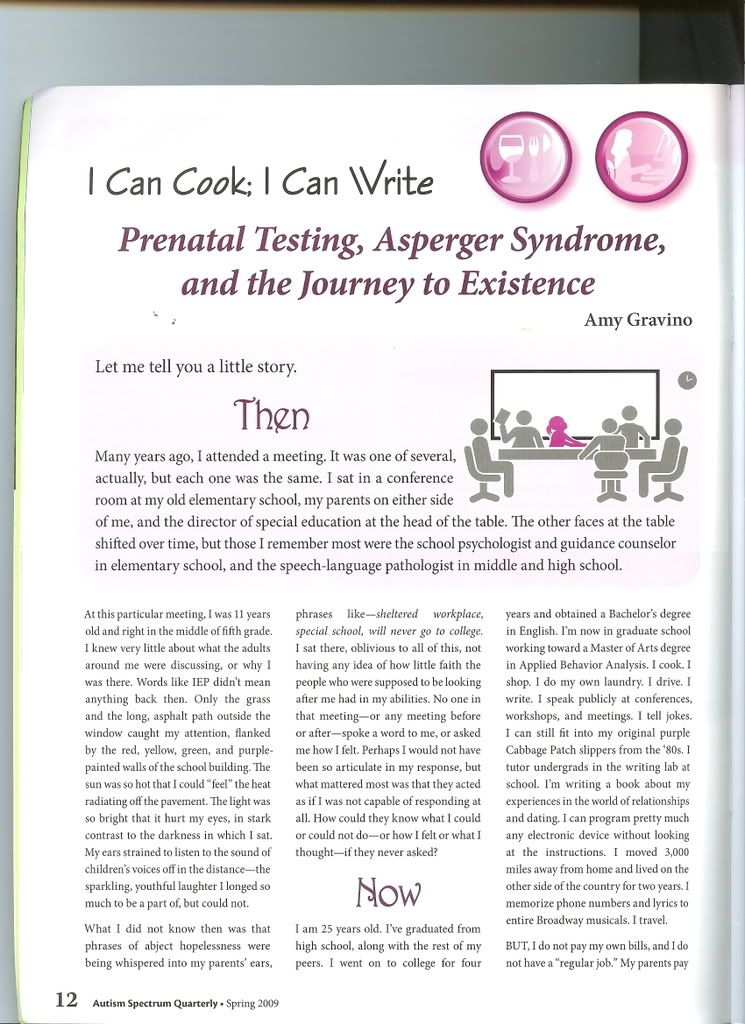
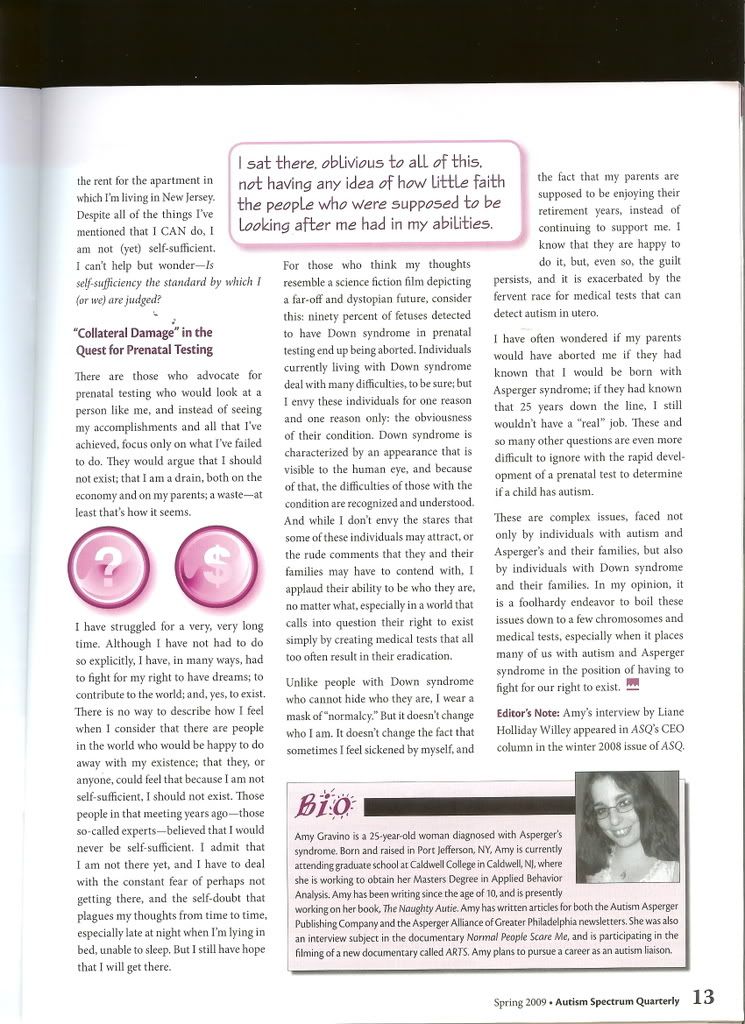
Hello, folks! Just days after I put up my last blog entry, I received my copies of Autism Spectrum Quarterly in the mail! So, as promised, I am now posting my article, titled "I Can Write, I Can Cook: Asperger's Syndrome, Prenatal Testing, and the Journey to Existence."

I know that prenatal testing is somewhat of a controversial topic, and while it is not the heart of my piece, it does play a strong role in it. The genesis of the piece actually came after a post I'd read on a message board months ago that referred to individuals with Down's Syndrome as "glorified pets." The same person who wrote that also pondered why anyone would want to bring into this world "someone who will never be self-sufficient." Those words pierced me like a blade, as I am not yet what one might define as "self-sufficient," and I wondered then how many people, both in the past and now, have or would call my existence into question because of that. So this piece was born of that fear, that pain, and my desire to redefine what "self-sufficient" really means.

Also, if anyone is wondering, yes, I did write a blog about this, and that blog is what became this article. I've edited it and tweaked it a bit since the original writing, so the finished product is different from the initial blog that I wrote.

So, without further ado, I present you now with my article, "I Can Cook, I Can Write: Asperger's Syndrome, Prenatal Testing, and the Journey to Existence," currently featured in the Spring 2009 issue of Autism Spectrum Quarterly:

Page One


Page Two


EDITED TO ADD: Here is the original text, for those having difficulty reading the article (I apologize if anyone has had trouble with the jpegs).

"I Can Cook, I Can Write: Asperger's Syndrome, Prenatal Testing, and the Journey to Existence"
by Amy Gravino

Let me tell you a little story.

Then

Many years ago, I attended a meeting. It was one of several, actually, but each one was the same. I sat in a conference room at my old elementary school, my parents on either side of me, and the director of special education at the head of the table. The other faces at the table shifted over time, but those I remember most were the school psychologist and guidance counselor in elementary school, and the speech-language pathologist in middle and high school.

At this particular meeting, I was 11 years old and right in the middle of fifth grade. I knew very little about what the adults around me were discussing, or why I was there. Words like IEP didn't mean anything back then. Only the grass and the long, asphalt path outside the window caught my attention, flanked by the red, yellow, green, and purple-painted walls of the school building. The sun was so hot that I could “feel” the heat radiating off the pavement. The light was so bright that it hurt my eyes, in stark contrast to the darkness in which I sat. My ears strained to listen to the sound of children's voices off in the distance—the sparkling, youthful laughter I longed so much to be a part of, but could not.

What I did not know then was that phrases of abject hopelessness were being whispered into my parents' ears, phrases like—sheltered workplace, special school, will never go to college. I sat there, oblivious to all of this, not having any idea of how little faith the people who were supposed to be looking after me had in my abilities. No one in that meeting—or any meeting before or after—spoke a word to me, or asked me how I felt. Perhaps I would not have been so articulate in my response, but what mattered most was that they acted as if I was not capable of responding at all. How could they know what I could or could not do—or how I felt or what I thought—if they never asked?

Now

I am 25 years old. I’ve graduated from high school, along with the rest of my peers. I went on to college for four years and obtained a Bachelor’s degree in English. I'm now in graduate school working toward a Master of Arts degree in Applied Behavior Analysis. I cook. I shop. I do my own laundry. I drive. I write. I speak publicly at conferences, workshops, and meetings. I tell jokes. I can still fit into my original purple Cabbage Patch slippers from the '80s. I tutor undergrads in the writing lab at school. I'm writing a book about my experiences in the world of relationships and dating. I can program pretty much any electronic device without looking at the instructions. I moved 3,000 miles away from home and lived on the other side of the country for two years. I memorize phone numbers and lyrics to entire Broadway musicals. I travel.

BUT, I do not pay my own bills, and I do not have a "regular job." My parents pay the rent for the apartment in which I’m living in New Jersey. Despite all of the things I've mentioned that I CAN do, I am not (yet) self-sufficient. I can’t help but wonder—is self-sufficiency the standard by which I (or we) are judged?

"Collateral Damage" in the Quest for Prenatal Testing

There are those who advocate for prenatal testing who would look at a person like me, and instead of seeing my accomplishments and all that I’ve achieved, focus only on what I’ve failed to do. They would argue that I should not exist, that I am a drain, both on the economy and on my parents. A waste—at least that’s how it seems.

I have struggled for a very, very long time. Although I have not had to do so explicitly, I have, in many ways, had to fight for my right to have dreams; to contribute to the world; and, yes, to exist. There is no way to describe how I feel when I consider that there are people in the world who would be happy to do away with my existence; that they, or anyone, could feel that because I am not self-sufficient, I should not exist. Those people in that meeting years ago—those so-called experts—believed that I would never be self-sufficient. I admit that I am not there yet, and I have to deal with the constant fear of perhaps not getting there, and the self-doubt that plagues my thoughts from time to time, especially late at night when I’m lying in bed, unable to sleep. But I still have hope that I will get there.

For those who think my thoughts resemble a science fiction film depicting a far-off and dystopian future, consider this: ninety percent of fetuses detected to have Down syndrome in prenatal testing end up being aborted. Individuals currently living with Down syndrome deal with many difficulties, to be sure; but I envy these individuals for one reason and one reason only: the obviousness of their condition. Down syndrome is characterized by an appearance that is visible to the human eye, and because of that, the difficulties of those with the condition are recognized and understood. And while I don't envy the stares that some of these individuals may attract, or the rude comments that they and their families may have to contend with, I applaud their ability to be who they are, no matter what, especially in a world that calls into question their right to exist simply by creating medical tests that all too often result in their eradication.

Unlike people with Down syndrome who cannot hide who they are, I wear a mask of "normalcy." But it doesn't change who I am. It doesn't change the fact that sometimes I feel sickened by myself, and the fact that my parents are supposed to be enjoying their retirement years, instead of continuing to support me. I know that they are happy to do it. But, even so, the guilt persists, and it is exacerbated by the fervent race for medical tests that can detect autism in utero.

I have often wondered if my parents would have aborted me if they had known that I would be born with Asperger syndrome; if they had known that 25 years down the line, I still wouldn't have a "real" job. These and so many other questions are even more difficult to ignore with the rapid development of a prenatal test to determine if a child has autism.

These are complex issues, faced not only by individuals with autism and Asperger's and their families, but also by individuals with Down syndrome and their families. In my opinion, it is a foolhardy endeavor to boil these issues down to a few chromosomes and medical tests, especially when it places many of us with autism and Asperger’s syndrome in the position of having to fight for our right to exist.

Editor’s Note: Amy’s interview by Liane Holliday Willey appeared in ASQ’s CEO column in the winter 2008 issue of ASQ.

Monday, February 23, 2009

Book News + An Exciting Conference Coming Up!

I can't believe I haven't updated since December. It's not that a great many life-shattering events have occurred since then (they haven't); but it's a new year now, and it just isn't right that I haven't rung it in here on my little blog of bloggishness.

The first bit of news I can share is that I've (finally) created a schedule for writing my book. My mom came over a few weekends ago, and we sat down and mapped out which chapters I'm going to write during each week. I have these color-coded printouts of every month from January to May hanging neatly up above my desk. The goal is to have the writing itself done by April 1st, and the editing done by the end of May. This is all provided that I stick to the schedule, which is a hell of a lot easier said than done. But I will try my best.

In other news, the article that I wrote for the Spring 2009 issue of Autism Spectrum Quarterly has finally gone to press! It's called "I Can Cook, I Can Write: Prenatal Testing, Asperger Syndrome, and the Journey to Existence," and you can read a little blurb about it here: http://www.asquarterly.com on ASQ's website. I'll post the full article up here, as was done with the last one, once I have a copy of it and have it online.

I have some other things I'd like to write about, but I'm going to reserve them for a future entry and instead take a moment to tell you all about a great event that's coming up. Caldwell College, where I attend graduate school, is having a conference in April titled, "Innovations in Autism Treatment and Applied Behavior Analysis: A Conference for Professionals, Teachers, Parents, and Caregivers of Children with Autism." It will feature over 10 professional luminaries in the field of behavior analysis, including Dr. Bill Heward, BCBA; Dr. Gina Green, BCBA; Dr. Gregory MacDuff, and more.

The conference is scheduled to take place on two consecutive Fridays; April 17th and April 24th. For more information, including registration details, click the banner below:


I know it may seem slightly stodgy and more research-based than many parents find accessible, but I cannot recommend this conference highly enough. These speakers are all incredibly well-versed in ABA, and believe in working toward the goal of helping to improve the lives of individuals with autism and their families. That's where the "applied" in "applied behavior analysis" comes in. These people aren't standing in a cold laboratory all day long. They're going out into schools and other settings in the community, working with paraprofessionals and parents alike to heighten the quality of life for people with autism. Anyone who's looking to learn more about ABA, or to keep abreast of the latest autism research developments will not want to miss this conference.

Attendees have the option of registering for one or both days of the conference, and if you register for both at the same time, there is a reduced fee. To see the full conference brochure, click here (you must have Adobe Acrobat to view it). Make sure to register as soon as possible, because registration fees increase after March 1st. So go get a-clicking and sign up today!

Monday, October 20, 2008

Herstory 12th Anniversary Gala & Luncheon

Yesterday, I read the introduction to my book, "The Naughty Autie," at Herstory's 12th Anniversary Gala and Luncheon, which was held at the Charles B. Wang Center at Stony Brook University. I think it went extraordinarily well, and I'm so happy to have gotten it on video so that I can share it with you all. The audio is also much clearer than that from the video of my Gersh Academy speech. So, without further ado, here is my reading (and if you'd like to pass it on, the link is http://www.youtube.com/watch?v=PRw6Qod9oG8):


Sunday, September 7, 2008

The Journey to Existence

Now more than ever, the debate is raging over the advent of prenatal testing for autism. Already, prenatal testing exists for Down's syndrome, and approximately 90% of Down's syndrome fetuses are aborted. One of the biggest concerns among those in the autistic/Asperger's-rights movement is that if/when prenatal testing for autism comes to fruition, that autistic fetuses will be aborted at the same rate as Down's syndrome fetuses.

I'm a member of a messageboard for fans of the director Kevin Smith. Last night, a member of that board made a thread in the off-topic forum titled, "Would you abort a pregnancy due to fetal Down's syndrome?" Rather than engaging in a sound, rational discussion, the person who started this thread resorted to tactless and emotionally charged statements such as,
"I see no good reason to sire an individual who will never be self-sufficient" and then later in the thread referred to individuals with Down's syndrome as "glorified pets."

Suffice it to say, this thread struck a chord in me. I felt a real need to stand up and say something, and so I did. I think that what I wrote is quite germane to the topic of prenatal testing, and so I have edited my response and submitted it to the magazine/journal Autism Spectrum Quarterly for publication. For those wanting backstory, here is a link to the thread. Here now is what I originally posted in the thread:

"Let me tell you a little story.

Many years ago, I attended a meeting. It was one of several, actually, but each was the same. I sat in a conference room at my old elementary school, my parents on either side of me, and the director of Special Ed at the head of the table. The other faces at the table shifted over time; Dr. Stolzberg, the elementary school psychologist; Mrs. Sigda, the guidance counselor; Mrs. Levin, the speech-language pathologist in middle and high school.

But I was 11 years old at this particular meeting, right smack dab in the middle of fifth grade. I knew very little about what the adults around me were discussing, or why I was there. Words like "IEP" didn't mean anything back then. Only the grass and the long, asphalt path outside the window caught my attention, flanked by the red, yellow, green, and purple-painted walls of the school building. The sun was so hot that I could feel the heat radiating off of the pavement. The light was so bright that it hurt my eyes, in stark contrast to the darkness in which I sat. And my ears strained to listen to the sound of children's voices off in the distance; the sparkling, youthful laughter I longed so much to be a part of, but could not.

What I did not know then were the phrases of abject hopelessness being whispered into my parents' ears. Phrases like, "sheltered workplace," "special school," "will never go to college." I sat there, oblivious to all of this, never having any idea of how little faith the people who were supposed to be looking after me had in my own abilities. And no one in that meeting, or any meeting before or after, spoke a word to me, or asked me how I felt. Perhaps I would not have been so articulate in my response, but it was they who believed I was not capable of responding at all. How could they know what I could or could not do if they never asked?

I'm 25 years old now. I graduated high school with the rest of my peers. I went on to college for four years and obtained a Bachelors degree in English. I'm now in graduate school going for a Master of Arts degree in Applied Behavior Analysis. I cook. I shop. I do my own laundry. I drive. I write. I speak publicly at conferences, workshops, meetings. I tell jokes. I can still fit into my original purple Cabbage Patch slippers from the '80s. I tutor undergrads in the writing lab at school. I'm writing a book about my experiences in the world of relationships and dating. I can program pretty much any electronic device without looking at the instructions. I moved 3,000 miles away from home and lived on the other side of the country for two years. I memorize phone numbers and lyrics to entire Broadway musicals. I travel.

But, I do not pay my own bills. I do not have a "regular job." My parents pay my rent for the room in which I'm living in a house in New Jersey. Despite all of the things I've mentioned in my previous paragraph, I am not (yet) self-sufficient. And by your reckoning, Mr. Übermensch, because of this, I should not exist. I am a drain, both on the economy and on my parents. A waste.

I have struggled for a very, very long time. Although I have not had to do so explicitly, I have, in many ways, had to fight for my right to have dreams, to contribute to the world. And, to exist. There is no way to describe how I felt reading what you wrote. That you, or anyone, could feel that because I am not self-sufficient, I should not exist. Those people in that meeting years ago, those so-called experts, believed that I would never be self-sufficient. I admit that I am not there yet, and I have to deal with the constant fear of never getting there, the self-doubt that plagues my thoughts from time to time, especially late at night when I'm lying in bed, unable to sleep.


I know this reply is rather bloggish, and for that I do apologize, but this thread struck something of a personal chord in me. Individuals with Down syndrome deal with many difficulties. But I envy these individuals for one reason, and one reason only: the obviousness of their condition. The fact is that Down's syndrome is visible to the human eye, and when people see them, they know. And while I don't envy the stares and the gawking these individuals must contend with, the rude comments and questions which they and their families are no doubt bombarded with, I applaud them for being who they are, no matter what, especially in a world that feels they should not exist. They truly cannot hide who they are. I wear a mask, a mask of "normalcy." But it doesn't change who I am. It doesn't change the fact that sometimes I feel sickened by myself and the fact that my parents are supposed to be enjoying their retirement years instead of continuing to support me. I know they are happy to do it. But the guilt persists. And the last thing I ever expected or wanted was to find a thread on here that not only exacerbated that guilt, but even broadened it.

I have wondered often if my parents would have aborted me if they'd known that I had Asperger's syndrome. If they'd known that 25 years down the line, I still wouldn't have yet had a "real" job. And so I really have to marvel at anyone who can take all of these complex issues, issues faced both by individuals with Asperger's and their families, and individuals with Down's syndrome and their families, and boil it all down to a few chromosomes. I just hope that you'll never have to be in a position to fight for your right to exist as I and many others have had to do. I don't think you'll like it very much."

~*~

Ignorance is an ugly and difficult spectre with which to contend. All I really wanted was to make people think, even for just a moment. It's very difficult to shake someone out of their ignorance, and a fight over such things has nowhere to go but back and forth. What I want is to elevate people, to lift them up from where they are now and to show them something different. A view of the world that they've never seen before. That's why I'm in the field I'm in now, why I speak at conferences, why I'm writing my book. To educate people, to help them learn how to help people like me, people with Down's syndrome, people with all sorts of neurobiological disorders. That's one of the biggest reasons why the prenatal thing drives me bonkers--because as important as the lives of future people are, the lives of people who are already here matter, too. There are so many people speaking for the unborn, but hardly anyone is speaking for those who already exist but are not truly "alive," because the world has not given them the tools to be alive. So that's what I'm trying to do.


Edited to Add, for Clarification: I am vehemently pro-choice. I am not telling anyone not to abort a Down's syndrome fetus, and while I don't think I myself would have an abortion, I'll be damned if I'm going to tell another woman what to do with her body. I wrote what I wrote in response to the person in that thread calling individuals with Down's syndrome "glorified pets" and saying "I see no reason to sire an individual who will never be self-sufficient." My point is that he meant that Down's syndrome individuals aren't self-sufficient, but there are others of us on the neurobiological continuum who aren't, either; yet, people like me would never be seen as "glorified pets" (or at least I would certainly hope not). But his idea of self-sufficiency is one that reaches across the spectrum of disorders, not just Down's. So my point was that how long would it be before prenatal testing comes to exist for Asperger's and autism? Already, 90% of Down's syndrome fetuses are aborted. My fear is that rate applying to fetuses with autism and Asperger's if/when prenatal testing for those disorders comes to fruition. That's all that I meant. I certainly do not mean that I face the exact same issues as individuals with Down's syndrome. But I have had just as many struggles, and my point is that people with Down's are more recognized--people see them and know they have a problem. People don't see that with me, don't see that I might not be as high-functioning as I appear, and that's what makes everything harder.