Showing posts with label conference. Show all posts
Showing posts with label conference. Show all posts
Monday, December 15, 2014
Keynote Speech at AHA-NY's Fall Autism Conference
Happy Holidays, folks! I am so happy to be able to share with you video of my first-ever keynote speech, about my experiences in school and growing up as a girl on the autism spectrum, which I gave at AHA-NY's 2014 Fall Autism conference in Holbrook, New York this past October. It's a bit long, but I hope you'll all take the time to watch it when you can. And please feel free to share this with anyone you think might be interested. Thank you!

Thursday, October 9, 2014
October Speaking Appearances!
Hello, folks! Just wanted to share with you that I will be speaking at two autism conferences this month. The first is AHA-NY's 24th Annual Fall Conference, at which I will be giving my first ever keynote address, on my experiences in school as a child on the autism spectrum. The conference will be held at Eastern Suffolk BOCES in Holbrook, NY on October 20th:
The second speaking engagement that I have lined up is a workshop on autism and sexuality at Autism New Jersey's 32nd Annual Conference, which I will be co-presenting with Dr. Peter Gerhardt and autism self-advocate Jason Ross. The conference will be held at the Atlantic City Convention Center in Atlantic City, NJ on October 23rd:
Audio recordings of both presentations will be available after the conferences, and I am hoping to possibly have my keynote speech video-recorded. I will post links to all recordings as soon as they are available. And if you're anywhere near either of these conference venues, I'd love to see you in person! Plus, you'll be in for a great day or two of informative and interesting autism-related presentations and discussions.
Thanks, everyone, and keep checking back for more posts about future speaking appearances!
 |
| (Click here to view conference brochure) |
 |
| (Click here to view conference brochure) |
Thanks, everyone, and keep checking back for more posts about future speaking appearances!
Friday, April 27, 2012
AHA-NY's Annual Spring Autism Conference

The subject of the workshop was the implications of the forthcoming changes to the DSM-5--specifically, the removal of the Asperger's Syndrome and PDD-NOS diagnoses, and the implementation of the broader "Autism Spectrum Disorders" diagnosis.
Saturday, February 27, 2010
The Beat Goes On...
I've got more news to share with you, my fine-feathered blog readers. As you may recall, I mentioned that I was waiting to hear from the Autism Society of America in regard to a proposal I sent in to present at their annual conference in Dallas this year. Well, I finally got a response, and it seems that my proposal was not accepted. I'm disappointed, to be sure, but I have remained optimistic, because I know I can always try again next year.
You may have heard the old saying, "When one door closes, another one opens." I've never put much stock in this idiom, though I have seen it happen to others. But something that happened to me recently made me into a true believer.
Not two days after receiving the rejection from the Autism Society of America, I got an e-mail from Pat Schissel, president of AHA-NY, whom I've known for a very long time. In the e-mail, she asked me to be a moderator for a panel at AHA-NY's annual Spring conference in May! Well, I was ecstatic as can be, and I readily accepted her offer. It's as if that was waiting for me all along and I just had to experience the bad before getting to the good.
In addition, I also got to do a radio interview last week on the Strange Dave Show. I was caught quite off-guard when he e-mailed me to request the interview, but happy that I was able to talk about autism and my public speaking career (as well as the Monkees, which is what became the focus of the interview as it went on). If you're interested in listening, click here (click ahead to the 36:25 mark, as that is where it begins).
Finally, this past Wednesday (February 24th), I attended a "Think Tank" at Autism Speaks' headquarters on Park Avenue in NYC. The purpose was to discuss the Community Life issues from the AFAA Town Hall meeting that I attended in November. Linda Walder Fiddle had asked me to be a part of this, along with Michael John Carley (Executive Director of GRASP). There were six of us in attendance altogether--Michael, Linda, Lisa Goring (Director of Family Services at Autism Speaks), Peter Bell (Executive V.P. of Programs and Services), and Dr. Gary Mesibov (Director of Division TEACCH) who conference-called with us from North Carolina.
I had felt some trepidation about going to Autism Speaks for this event, as it was like walking into the belly of the proverbial beast. I didn't know what it would be like--if I would be pandered or condescended to, in a sense, or relegated to the corner and not permitted to speak at all. Luckily, neither of these ended up being the case. I was quiet in the beginning, trying to absorb all that was going on (the echo from the speakerphone didn't help matters), and then once I felt more at ease, I began to share my thoughts on different topics.
Having Michael and Linda there was a tremendous help, of course, and soon I was speaking passionately about the need for certain services or pieces of legislation that could be drafted to answer this problem or that concern. As little expertise as I have in the legal field (very little), I was still able to offer my ideas and have them not only received, but also lauded.
I know there is a great fracture between several parts of the autism community and Autism Speaks. Maybe some spectrumites will see me as a Benedict Arnold type for going onto "enemy territory." Yet I feel like the best way to enact change and bring our perspectives to Autism Speaks is to do just that. Even though my opinions were met with enthusiasm and respect, I am well aware that this hasn't been the case for many others on the spectrum. With these efforts, I'm hoping to change this, to show Autism Speaks the value of the input those of us on the spectrum have to offer.
After the meeting, Linda and I went over to Bergdorf Goodman, a high-end department store on Fifth Avenue. I had always dreamed of having lunch in their restaurant on the 7th floor, with its astonishing view of the park and high-backed chairs that looked like something out of a fairy tale. All of these thoughts swirled through my mind as I sat there nibbling on perfectly seasoned pieces of toasted lavash. There really is so much work to be done, and at that moment, the reality of how this is going to be what I'm going to do for the rest of my life sunk in.
I don't mind, though. On the contrary, I find it to be the most satisfying and important work I could ever do. My Masters thesis, which I am in the midst of as we speak, is also going towards that effort, as is my book, "The Naughty Autie." Every article I write, every presentation I give and public speaking gig I do is a part of it. Though I've only just begun to do this, the Asperger's syndrome college coaching is most definitely a part of it.
In a lot of places, awareness still needs to be raised. One thing I told the members of the Think Tank is that before anything else can be done, any laws enacted or programs funded, people have to know what the heck autism and Asperger's syndrome are. Awareness is paramount. Linda told me of a community where they're looking to construct a low-income apartment building for people with Asperger's to live in, and the folks in the community are fighting against it. Interestingly, it's largely a black community, and given the discrimination these individuals have no doubt faced, you wouldn't think they would turn around and do the same to another group of people.
It's all about fear. People fear what they don't understand and don't know, and that's what's happening here. These people think that individuals with AS are dangerous, somehow, or criminals, or God knows what. Linda asked me if I'd want to go speak to the community in April, to explain what Asperger's is and hopefully abate their concerns so that the plans for the building can move forward. I readily accepted, because the prejudice against those on the spectrum disturbs and saddens me, and knowledge is the first step to eradicating it.
One concept that was brought up at the Think Tank was the idea of autism apologists, of how many people on the spectrum have a hard time getting services because the economic costs make them feel they have to apologize for needing these services. I mentioned how this is interesting because I have been told by many of my friends that I tend to over-apologize for things. It's the result of a lifetime of constantly being made to feel that I am always wrong. It's taken me so many years to finally look the world in the eye and say:
"I'm not sorry."
I have grown so tired of being sorry for the way that I am. For who I am. Too many years of my life were spent walking with my head down, never seeing what was going on around me. You miss a whole heck of a lot when you go through life like that, and no one--on the spectrum or not--should have to feel that way. So I expressed to the Think Tank that no one should have to be sorry for who they are and needing the services and supports that would help them to get along better in this world, and, ultimately, be successful in it.
As simple a statement as "I'm not sorry" is, it distills a greater idea into a succinct, direct thought, which is exactly what's necessary in today's sound byte world. My great hope is that it becomes more than a sound byte, however, and moves the hearts and minds of persons whose seat of authority grants them the power to make real, broad changes in the lives of individuals on the autism spectrum.
Well...that's about all I've got to say for now. On deck for my next entry is a look at Asperger's syndrome and food--what my relationship to food used to be, what it is now, and how it's changed so dramatically over the years. It's the story of an impossibly picky eater who turned into a veritable gourmand--and for whom cooking has become her first-ever "perseverative interest."
You may have heard the old saying, "When one door closes, another one opens." I've never put much stock in this idiom, though I have seen it happen to others. But something that happened to me recently made me into a true believer.
Not two days after receiving the rejection from the Autism Society of America, I got an e-mail from Pat Schissel, president of AHA-NY, whom I've known for a very long time. In the e-mail, she asked me to be a moderator for a panel at AHA-NY's annual Spring conference in May! Well, I was ecstatic as can be, and I readily accepted her offer. It's as if that was waiting for me all along and I just had to experience the bad before getting to the good.
In addition, I also got to do a radio interview last week on the Strange Dave Show. I was caught quite off-guard when he e-mailed me to request the interview, but happy that I was able to talk about autism and my public speaking career (as well as the Monkees, which is what became the focus of the interview as it went on). If you're interested in listening, click here (click ahead to the 36:25 mark, as that is where it begins).
Finally, this past Wednesday (February 24th), I attended a "Think Tank" at Autism Speaks' headquarters on Park Avenue in NYC. The purpose was to discuss the Community Life issues from the AFAA Town Hall meeting that I attended in November. Linda Walder Fiddle had asked me to be a part of this, along with Michael John Carley (Executive Director of GRASP). There were six of us in attendance altogether--Michael, Linda, Lisa Goring (Director of Family Services at Autism Speaks), Peter Bell (Executive V.P. of Programs and Services), and Dr. Gary Mesibov (Director of Division TEACCH) who conference-called with us from North Carolina.
I had felt some trepidation about going to Autism Speaks for this event, as it was like walking into the belly of the proverbial beast. I didn't know what it would be like--if I would be pandered or condescended to, in a sense, or relegated to the corner and not permitted to speak at all. Luckily, neither of these ended up being the case. I was quiet in the beginning, trying to absorb all that was going on (the echo from the speakerphone didn't help matters), and then once I felt more at ease, I began to share my thoughts on different topics.
Having Michael and Linda there was a tremendous help, of course, and soon I was speaking passionately about the need for certain services or pieces of legislation that could be drafted to answer this problem or that concern. As little expertise as I have in the legal field (very little), I was still able to offer my ideas and have them not only received, but also lauded.
I know there is a great fracture between several parts of the autism community and Autism Speaks. Maybe some spectrumites will see me as a Benedict Arnold type for going onto "enemy territory." Yet I feel like the best way to enact change and bring our perspectives to Autism Speaks is to do just that. Even though my opinions were met with enthusiasm and respect, I am well aware that this hasn't been the case for many others on the spectrum. With these efforts, I'm hoping to change this, to show Autism Speaks the value of the input those of us on the spectrum have to offer.
After the meeting, Linda and I went over to Bergdorf Goodman, a high-end department store on Fifth Avenue. I had always dreamed of having lunch in their restaurant on the 7th floor, with its astonishing view of the park and high-backed chairs that looked like something out of a fairy tale. All of these thoughts swirled through my mind as I sat there nibbling on perfectly seasoned pieces of toasted lavash. There really is so much work to be done, and at that moment, the reality of how this is going to be what I'm going to do for the rest of my life sunk in.
I don't mind, though. On the contrary, I find it to be the most satisfying and important work I could ever do. My Masters thesis, which I am in the midst of as we speak, is also going towards that effort, as is my book, "The Naughty Autie." Every article I write, every presentation I give and public speaking gig I do is a part of it. Though I've only just begun to do this, the Asperger's syndrome college coaching is most definitely a part of it.
In a lot of places, awareness still needs to be raised. One thing I told the members of the Think Tank is that before anything else can be done, any laws enacted or programs funded, people have to know what the heck autism and Asperger's syndrome are. Awareness is paramount. Linda told me of a community where they're looking to construct a low-income apartment building for people with Asperger's to live in, and the folks in the community are fighting against it. Interestingly, it's largely a black community, and given the discrimination these individuals have no doubt faced, you wouldn't think they would turn around and do the same to another group of people.
It's all about fear. People fear what they don't understand and don't know, and that's what's happening here. These people think that individuals with AS are dangerous, somehow, or criminals, or God knows what. Linda asked me if I'd want to go speak to the community in April, to explain what Asperger's is and hopefully abate their concerns so that the plans for the building can move forward. I readily accepted, because the prejudice against those on the spectrum disturbs and saddens me, and knowledge is the first step to eradicating it.
One concept that was brought up at the Think Tank was the idea of autism apologists, of how many people on the spectrum have a hard time getting services because the economic costs make them feel they have to apologize for needing these services. I mentioned how this is interesting because I have been told by many of my friends that I tend to over-apologize for things. It's the result of a lifetime of constantly being made to feel that I am always wrong. It's taken me so many years to finally look the world in the eye and say:
"I'm not sorry."
I have grown so tired of being sorry for the way that I am. For who I am. Too many years of my life were spent walking with my head down, never seeing what was going on around me. You miss a whole heck of a lot when you go through life like that, and no one--on the spectrum or not--should have to feel that way. So I expressed to the Think Tank that no one should have to be sorry for who they are and needing the services and supports that would help them to get along better in this world, and, ultimately, be successful in it.
As simple a statement as "I'm not sorry" is, it distills a greater idea into a succinct, direct thought, which is exactly what's necessary in today's sound byte world. My great hope is that it becomes more than a sound byte, however, and moves the hearts and minds of persons whose seat of authority grants them the power to make real, broad changes in the lives of individuals on the autism spectrum.
Well...that's about all I've got to say for now. On deck for my next entry is a look at Asperger's syndrome and food--what my relationship to food used to be, what it is now, and how it's changed so dramatically over the years. It's the story of an impossibly picky eater who turned into a veritable gourmand--and for whom cooking has become her first-ever "perseverative interest."
Wednesday, November 4, 2009
Thoughts on My First Workshop Presentation
Last month, from October 9-11, I attended and presented a workshop at Autism New Jersey's annual conference in Atlantic City. I have a lot of thoughts on how the presentation went, and so I thought I'd share them here.
Let me preface this by saying that the presentation would not have happened at all had it not been for Dr. Lynda Geller. ANJ initially rejected my presentation proposal, but I was able to get the Executive Director, Linda Meyer (who was also one of my professors last semester) to reconsider, provided I could bring someone else on board who had a bit more in the way of credentials and expertise. Lynda has both of those in spades, and I am and always will be eternally grateful to her for agreeing to present with me.
Our presentation was titled, "Look Out, Here Comes Tomorrow: Strategies for Transitioning Students with Asperger's Disorder to a College Setting." It's probably fairly obvious, but I am the one who came up with the workshop name, since it has a Monkees song title in it. I'm just glad Lynda had enough of a sense of humor and graciousness to go along with it.
When I submitted the workshop proposal way back in February, I had intended myself to be the sole presenter. When Lynda came on board, I knew things were going to be different, for a number of reasons. I'd never presented a workshop before, for one, and I'd never done any sort of presentation in concert with another professional. It's always been me up until now...the Amy Gravino show, if you will, speaking on panels and doing a few keynotes. A co-presentation was a very new thing for me, and so I did not know what to expect.
It seemed like we did not really collaborate on the presentation at all, at least up until the last week before the conference. Lynda's incredibly busy schedule made it difficult reach her by phone or e-mail, and as the date of the conference grew nearer, my anxiety (understandably) heightened. I knew she would be absolutely good to go no matter what, but, while I've done tons of presentations on my own, this was the first with someone else, and I felt like it would be helpful to me if knew what she had planned and where I came in.
Had I been the sole presenter, I certainly would have designed my own Powerpoint presentation months ago. Lynda, however, having done a presentation of her own at countless conferences, brought a Powerpoint with her, so that was helpful in solving that issue, as I didn't have to worry about creating my own. The only problem was that I felt a bit out of place because it was she who presented for the bulk of the workshop. My contribution ended up being around 20 to 25 minutes' worth of personal anecdotes, as a means of supplementing the Powerpoint. I didn't mind doing this, although all I had to work from were a few notes hastily scribbled onto a wrinkled piece of paper, but it just wasn't exactly what I'd dreamed of when I thought of what my first workshop would be like.
Another issue is that we only had eight people in attendance at our workshop. Two were my parents, and another was my thesis chair. I know he could have gone to any other workshop, but he was kind enough to come to mine, and it meant a lot to me. As Lynda and I were setting up, I had asked the Autism New Jersey volunteer how many people signed up. "Fifteen," she said. I was disheartened by this; even more so when only eight showed up.
Part of the reason perhaps why the turnout was so low was that it was the last workshop of the day. Many people become exhausted by then, after a full day of conferencing, and so they just take off. Given that the location of this conference was Atlantic City, people have even more reason to leave early. Still, it bothered me. Almost all of the workshops that I attended at the conference dealt with issues faced by adults on the spectrum...and all of them had low numbers of attendees.
I attended a workshop on Saturday that was somewhat similar to mine, as it was about transitioning students with autism spectrum disorders from high school to college. The man who presented it was named Vincent Varrassi, and he used to work at Fairleigh Dickinson University, but now practices privately. I remembered him because I had e-mailed him some months ago about college coaching for people with Asperger's, and he provided some very thoughtful and helpful advice in his response.
I was, therefore, delighted when I discovered that he'd be presenting a workshop at the conference. He'd brought with him two young men with Asperger's with whom he works as clients. They chimed in periodically with anecdotal stories to supplement Mr. Varrassi's Powerpoint. The number of attendees there was even smaller than in my workshop, but in this case, the intimate group allowed for a great back-and-forth dialogue between all of us. In particular, I found myself chiming in on the issues that the guys were talking about, offering insights based on my own experiences. Strangely enough, I felt more comfortable speaking there than I had felt in my own workshop.
After the workshop ended, I went up to Mr. Varrassi to speak with him, and he remembered who I was from the e-mails. He said that just from listening to me speak there in the audience, that I was a "natural," and he wanted to know if I would like to join him and the guys ("our merry band of travelers" was how he put it, I think) when they go speaking at various conferences. Of course, I agreed. He said he wanted to keep in touch with me, so we exchanged business cards as we continued chatting on the way to the escalators.
To get back to the issue of low attendance at these workshops, I know that right now, parents of children on the autism spectrum are faced with an overwhelming number of problems, which is why conferences like this even exist in the first place. But one day those children won't be children anymore. They will turn 18, and what will happen to them? In terms of services and supports, they will drop right off the proverbial cliff. There is nothing, or almost nothing, out there for adults with autism and Asperger's syndrome.
Yet they do exist. These people are not some fantastic myth spun out of the webs of time--they are very real individuals whose lives have been put on hold because they do not have the tools necessary to be successful in society. Many still live at home with their parents and are support by them--but what happens when these parents die? What will happen to the children on the spectrum when their parents die? As many questions and concerns as there are floating around right now, that should be first and foremost in these people's minds, always knowing that one day, their 5-year-old will be 25, and will need to have a way to survive on their own.
So the lack of attendance at these workshops, while not entirely unexpected, still left me wondering when everyone else is going to wake up and catch sight of the tsunami of adolescents on the spectrum who are heading straight for the shores of adulthood and will surely crash and collapse without the assistance and support that they need.
But finally, perhaps the reason I had so few people attend my workshop is that it's simply a rite of passage. Like how someone who is nominated for an Emmy for the first time never wins. If it is just a one-time thing, then I am not so perturbed by it, and I have faith that the turnout next year will be better. I just hope that I don't become the Susan Lucci of autism conferences. Yikes.
So, even though things didn't go quite how I'd hoped, I'm still glad that I presented at Autism New Jersey's annual conference. I'm now focused on presenting again next year, and what I anticipate presenting is my finished thesis study and the data gleaned therein. I think it will be very interesting and I want to share it with the world because of the social significance of such a study, as no one has ever taught dating skills to adults with Asperger's before using the principles of applied behavior analysis. Look out, here comes tomorrow...
Here also is a video of my presentation from the conference. The first four minutes are the remainder of Lynda's portion of the presentation, and the rest is mine:
Let me preface this by saying that the presentation would not have happened at all had it not been for Dr. Lynda Geller. ANJ initially rejected my presentation proposal, but I was able to get the Executive Director, Linda Meyer (who was also one of my professors last semester) to reconsider, provided I could bring someone else on board who had a bit more in the way of credentials and expertise. Lynda has both of those in spades, and I am and always will be eternally grateful to her for agreeing to present with me.
Our presentation was titled, "Look Out, Here Comes Tomorrow: Strategies for Transitioning Students with Asperger's Disorder to a College Setting." It's probably fairly obvious, but I am the one who came up with the workshop name, since it has a Monkees song title in it. I'm just glad Lynda had enough of a sense of humor and graciousness to go along with it.
When I submitted the workshop proposal way back in February, I had intended myself to be the sole presenter. When Lynda came on board, I knew things were going to be different, for a number of reasons. I'd never presented a workshop before, for one, and I'd never done any sort of presentation in concert with another professional. It's always been me up until now...the Amy Gravino show, if you will, speaking on panels and doing a few keynotes. A co-presentation was a very new thing for me, and so I did not know what to expect.
It seemed like we did not really collaborate on the presentation at all, at least up until the last week before the conference. Lynda's incredibly busy schedule made it difficult reach her by phone or e-mail, and as the date of the conference grew nearer, my anxiety (understandably) heightened. I knew she would be absolutely good to go no matter what, but, while I've done tons of presentations on my own, this was the first with someone else, and I felt like it would be helpful to me if knew what she had planned and where I came in.
Had I been the sole presenter, I certainly would have designed my own Powerpoint presentation months ago. Lynda, however, having done a presentation of her own at countless conferences, brought a Powerpoint with her, so that was helpful in solving that issue, as I didn't have to worry about creating my own. The only problem was that I felt a bit out of place because it was she who presented for the bulk of the workshop. My contribution ended up being around 20 to 25 minutes' worth of personal anecdotes, as a means of supplementing the Powerpoint. I didn't mind doing this, although all I had to work from were a few notes hastily scribbled onto a wrinkled piece of paper, but it just wasn't exactly what I'd dreamed of when I thought of what my first workshop would be like.
Another issue is that we only had eight people in attendance at our workshop. Two were my parents, and another was my thesis chair. I know he could have gone to any other workshop, but he was kind enough to come to mine, and it meant a lot to me. As Lynda and I were setting up, I had asked the Autism New Jersey volunteer how many people signed up. "Fifteen," she said. I was disheartened by this; even more so when only eight showed up.
Part of the reason perhaps why the turnout was so low was that it was the last workshop of the day. Many people become exhausted by then, after a full day of conferencing, and so they just take off. Given that the location of this conference was Atlantic City, people have even more reason to leave early. Still, it bothered me. Almost all of the workshops that I attended at the conference dealt with issues faced by adults on the spectrum...and all of them had low numbers of attendees.
I attended a workshop on Saturday that was somewhat similar to mine, as it was about transitioning students with autism spectrum disorders from high school to college. The man who presented it was named Vincent Varrassi, and he used to work at Fairleigh Dickinson University, but now practices privately. I remembered him because I had e-mailed him some months ago about college coaching for people with Asperger's, and he provided some very thoughtful and helpful advice in his response.
I was, therefore, delighted when I discovered that he'd be presenting a workshop at the conference. He'd brought with him two young men with Asperger's with whom he works as clients. They chimed in periodically with anecdotal stories to supplement Mr. Varrassi's Powerpoint. The number of attendees there was even smaller than in my workshop, but in this case, the intimate group allowed for a great back-and-forth dialogue between all of us. In particular, I found myself chiming in on the issues that the guys were talking about, offering insights based on my own experiences. Strangely enough, I felt more comfortable speaking there than I had felt in my own workshop.
After the workshop ended, I went up to Mr. Varrassi to speak with him, and he remembered who I was from the e-mails. He said that just from listening to me speak there in the audience, that I was a "natural," and he wanted to know if I would like to join him and the guys ("our merry band of travelers" was how he put it, I think) when they go speaking at various conferences. Of course, I agreed. He said he wanted to keep in touch with me, so we exchanged business cards as we continued chatting on the way to the escalators.
To get back to the issue of low attendance at these workshops, I know that right now, parents of children on the autism spectrum are faced with an overwhelming number of problems, which is why conferences like this even exist in the first place. But one day those children won't be children anymore. They will turn 18, and what will happen to them? In terms of services and supports, they will drop right off the proverbial cliff. There is nothing, or almost nothing, out there for adults with autism and Asperger's syndrome.
Yet they do exist. These people are not some fantastic myth spun out of the webs of time--they are very real individuals whose lives have been put on hold because they do not have the tools necessary to be successful in society. Many still live at home with their parents and are support by them--but what happens when these parents die? What will happen to the children on the spectrum when their parents die? As many questions and concerns as there are floating around right now, that should be first and foremost in these people's minds, always knowing that one day, their 5-year-old will be 25, and will need to have a way to survive on their own.
So the lack of attendance at these workshops, while not entirely unexpected, still left me wondering when everyone else is going to wake up and catch sight of the tsunami of adolescents on the spectrum who are heading straight for the shores of adulthood and will surely crash and collapse without the assistance and support that they need.
But finally, perhaps the reason I had so few people attend my workshop is that it's simply a rite of passage. Like how someone who is nominated for an Emmy for the first time never wins. If it is just a one-time thing, then I am not so perturbed by it, and I have faith that the turnout next year will be better. I just hope that I don't become the Susan Lucci of autism conferences. Yikes.
So, even though things didn't go quite how I'd hoped, I'm still glad that I presented at Autism New Jersey's annual conference. I'm now focused on presenting again next year, and what I anticipate presenting is my finished thesis study and the data gleaned therein. I think it will be very interesting and I want to share it with the world because of the social significance of such a study, as no one has ever taught dating skills to adults with Asperger's before using the principles of applied behavior analysis. Look out, here comes tomorrow...
Here also is a video of my presentation from the conference. The first four minutes are the remainder of Lynda's portion of the presentation, and the rest is mine:
Monday, February 23, 2009
Book News + An Exciting Conference Coming Up!
I can't believe I haven't updated since December. It's not that a great many life-shattering events have occurred since then (they haven't); but it's a new year now, and it just isn't right that I haven't rung it in here on my little blog of bloggishness.
The first bit of news I can share is that I've (finally) created a schedule for writing my book. My mom came over a few weekends ago, and we sat down and mapped out which chapters I'm going to write during each week. I have these color-coded printouts of every month from January to May hanging neatly up above my desk. The goal is to have the writing itself done by April 1st, and the editing done by the end of May. This is all provided that I stick to the schedule, which is a hell of a lot easier said than done. But I will try my best.
In other news, the article that I wrote for the Spring 2009 issue of Autism Spectrum Quarterly has finally gone to press! It's called "I Can Cook, I Can Write: Prenatal Testing, Asperger Syndrome, and the Journey to Existence," and you can read a little blurb about it here: http://www.asquarterly.com on ASQ's website. I'll post the full article up here, as was done with the last one, once I have a copy of it and have it online.
I have some other things I'd like to write about, but I'm going to reserve them for a future entry and instead take a moment to tell you all about a great event that's coming up. Caldwell College, where I attend graduate school, is having a conference in April titled, "Innovations in Autism Treatment and Applied Behavior Analysis: A Conference for Professionals, Teachers, Parents, and Caregivers of Children with Autism." It will feature over 10 professional luminaries in the field of behavior analysis, including Dr. Bill Heward, BCBA; Dr. Gina Green, BCBA; Dr. Gregory MacDuff, and more.
The conference is scheduled to take place on two consecutive Fridays; April 17th and April 24th. For more information, including registration details, click the banner below:

I know it may seem slightly stodgy and more research-based than many parents find accessible, but I cannot recommend this conference highly enough. These speakers are all incredibly well-versed in ABA, and believe in working toward the goal of helping to improve the lives of individuals with autism and their families. That's where the "applied" in "applied behavior analysis" comes in. These people aren't standing in a cold laboratory all day long. They're going out into schools and other settings in the community, working with paraprofessionals and parents alike to heighten the quality of life for people with autism. Anyone who's looking to learn more about ABA, or to keep abreast of the latest autism research developments will not want to miss this conference.
Attendees have the option of registering for one or both days of the conference, and if you register for both at the same time, there is a reduced fee. To see the full conference brochure, click here (you must have Adobe Acrobat to view it). Make sure to register as soon as possible, because registration fees increase after March 1st. So go get a-clicking and sign up today!
The first bit of news I can share is that I've (finally) created a schedule for writing my book. My mom came over a few weekends ago, and we sat down and mapped out which chapters I'm going to write during each week. I have these color-coded printouts of every month from January to May hanging neatly up above my desk. The goal is to have the writing itself done by April 1st, and the editing done by the end of May. This is all provided that I stick to the schedule, which is a hell of a lot easier said than done. But I will try my best.
In other news, the article that I wrote for the Spring 2009 issue of Autism Spectrum Quarterly has finally gone to press! It's called "I Can Cook, I Can Write: Prenatal Testing, Asperger Syndrome, and the Journey to Existence," and you can read a little blurb about it here: http://www.asquarterly.com on ASQ's website. I'll post the full article up here, as was done with the last one, once I have a copy of it and have it online.
I have some other things I'd like to write about, but I'm going to reserve them for a future entry and instead take a moment to tell you all about a great event that's coming up. Caldwell College, where I attend graduate school, is having a conference in April titled, "Innovations in Autism Treatment and Applied Behavior Analysis: A Conference for Professionals, Teachers, Parents, and Caregivers of Children with Autism." It will feature over 10 professional luminaries in the field of behavior analysis, including Dr. Bill Heward, BCBA; Dr. Gina Green, BCBA; Dr. Gregory MacDuff, and more.
The conference is scheduled to take place on two consecutive Fridays; April 17th and April 24th. For more information, including registration details, click the banner below:
I know it may seem slightly stodgy and more research-based than many parents find accessible, but I cannot recommend this conference highly enough. These speakers are all incredibly well-versed in ABA, and believe in working toward the goal of helping to improve the lives of individuals with autism and their families. That's where the "applied" in "applied behavior analysis" comes in. These people aren't standing in a cold laboratory all day long. They're going out into schools and other settings in the community, working with paraprofessionals and parents alike to heighten the quality of life for people with autism. Anyone who's looking to learn more about ABA, or to keep abreast of the latest autism research developments will not want to miss this conference.
Attendees have the option of registering for one or both days of the conference, and if you register for both at the same time, there is a reduced fee. To see the full conference brochure, click here (you must have Adobe Acrobat to view it). Make sure to register as soon as possible, because registration fees increase after March 1st. So go get a-clicking and sign up today!
Wednesday, December 3, 2008
Controversial Conferences, An Interview, and a Really Big Move
My last update came over a month ago, and now Thanksgiving has already come and gone. Unbelievable! And so much has happened since I last posted here. In just the week after the Herstory 12th Anniversary Gala reading, I spoke at two more events: the Special Day for Special Kids at the West Hills Day Camp in Huntington, NY on October 26th, and the New Jersey State Federation of Women's Clubs Annual Fall Conference at the Bridgewater Marriott in Bridgewater, NJ on October 27th. In the weeks that followed, I spoke at a social skills group for adults on the spectrum at the JCC in Manhattan, and then at an Asperger Girls' group at the Faye J. Lindner Autism Center in Bethpage, NY.
Conference-wise, I spoke on the "Transitions to Independence in ASD" panel at Kean University's "Autism: Putting the Pieces Together" conference on November 21st. I had never even heard of the university or the conference until my business manager Nicole told me about it. She had initially asked if I wanted to vendor a table with her, as she was going to reserve a vendor table for her company, Learning By Design, LLC. I readily accepted her offer, and that was when she told me that she'd spoken to the woman running the conference and had told her about me, and now there was a possibility that I'd get to speak on one of the panels. We waited a little longer, and after not hearing back from that woman for a few weeks, I took the reins and sent her an e-mail myself, expressing my interest. She responded, saying that she'd love to have me speak at the conference on the "Transition" panel. The rest, as they say, is history.
Now, this conference was different from ones I'd attended in the past, in that the keynote speaker was a proponent of DIR/Floortime, an autism therapy created by Dr. Stanley Greenspan. In fact, the speaker was his own son, Jake Greenspan. I knew from my classes at school that there is no scientific evidence that validates the claims made by Greenspan. Indeed, there is not one empirically validated research study attesting to DIR/Floortime's effectiveness. But, I felt it best to go into the conference with an open mind, and I had not been shy about mentioning my affiliation with Caldwell College and the ABA program when asking to speak on the panel, so the fact that they wanted me to speak there had to mean that they were willing to welcome other disciplines and those who subscribe to them. That did make me feel more comfortable with being there.
My comfort level slowly started to decrease, however, when in his speech, Mr. Greenspan took a few shots at the methods and practices of ABA. Of course, he made a (thinly-veiled) attempt to disguise the fact that it was ABA about which he was speaking, but Nicole and I knew the truth. Now, I'm not one to take pot shots back at someone, but the whole time I was sitting there, all I could think was, "This guy is saying things, and at the same time, not saying anything at all!" It was baffling. I'd been surprised enough when he first came out onstage; I was expecting an older, bespectacled, somewhat nerdy fellow, perhaps one who wore a brown corduroy blazer. But, Jake Greenspan was, in fact, a hunky piece of man-beef to the nth degree. I was stunned. What was this could-be GQ model doing delivering a keynote speech at an autism conference? It didn't take me very long to catch on, though. He was a figurehead, a puppet for his father sent to represent him and his creation, DIR/Floortime. After all, who better to have standing onstage before an audience than a dashing young man who could easily woo and sway the masses? A very clever ploy, indeed.
Let's get one thing straight, though: this is not about finger-pointing or feuding. There are too many families, too many children and adults with autism spectrum disorders who need help and answers, to engage in petty, childish rivalry. That's what really grated my cheese about Mr. Greenspan's comments; instead of encouraging a partnership, instead of urging differing schools of therapy to work together and cooperate, he furthered an agenda of division and animosity. It's really just sad, because it's individuals on the spectrum who are losing out in the end. I'm not a saint by any stretch of the imagination, but I intend to do my absolute best to rise above trading jabs at conferences and vying for professional or personal glory. That's not what I care about. My interest lies solely with doing everything I can to raise autism and Asperger's syndrome awareness, and to help the people who are here now, fighting to survive in this world. That's what matters most.
A large part of the reason I haven't updated in so long is because on November 5th, I moved from my old apartment in Caldwell to a new one in Upper Montclair. I'm now living with one of my best friends, Dan, who is from Long Island. I feel that where I am now is a major upgrade from where I used to live, both physically and psychologically. Before, I was just renting a room in a house; now, the whole space (a third floor of a house) is mine (and Dan's). It's so relieving to be able to stretch my wings at last, and to be rid of the stressors that plagued me over the last few months. I'm still settling in and getting used to things, and the fact that this move was in the middle of the semester made things really hard, but it's becoming easier, bit by bit. I think this place is going to help me be much more productive, in terms of both writing my book and carving out a career as an autism liaison.
Finally, I have one more thing to share with you all: I'm in print again! I was interviewed by Liane Willey for the Winter 2008 issue of Autism Spectrum Quarterly magazine. Diane Twachtman-Cullen, the magazine's Editor-in-Chief, accepted for publication an article that I wrote (it'll be in the February 2009 issue), and asked if I would want to be interviewed by Liane for the "C.E.O." (Celebrations of Excellence and Originality) column, as a lead-in piece. I readily agreed, and the issue is now finally in print. I haven't received my hard copy yet, but my parents got theirs a few days ago, and I had my dad scan the article so that I could disseminate it around the Interwebs (and I will do the same when the February 2009 issue comes out). So, here it is! (Click on the images to make them bigger.) If the thumbnails don't work, click here and here to read the article.


Conference-wise, I spoke on the "Transitions to Independence in ASD" panel at Kean University's "Autism: Putting the Pieces Together" conference on November 21st. I had never even heard of the university or the conference until my business manager Nicole told me about it. She had initially asked if I wanted to vendor a table with her, as she was going to reserve a vendor table for her company, Learning By Design, LLC. I readily accepted her offer, and that was when she told me that she'd spoken to the woman running the conference and had told her about me, and now there was a possibility that I'd get to speak on one of the panels. We waited a little longer, and after not hearing back from that woman for a few weeks, I took the reins and sent her an e-mail myself, expressing my interest. She responded, saying that she'd love to have me speak at the conference on the "Transition" panel. The rest, as they say, is history.
Now, this conference was different from ones I'd attended in the past, in that the keynote speaker was a proponent of DIR/Floortime, an autism therapy created by Dr. Stanley Greenspan. In fact, the speaker was his own son, Jake Greenspan. I knew from my classes at school that there is no scientific evidence that validates the claims made by Greenspan. Indeed, there is not one empirically validated research study attesting to DIR/Floortime's effectiveness. But, I felt it best to go into the conference with an open mind, and I had not been shy about mentioning my affiliation with Caldwell College and the ABA program when asking to speak on the panel, so the fact that they wanted me to speak there had to mean that they were willing to welcome other disciplines and those who subscribe to them. That did make me feel more comfortable with being there.
My comfort level slowly started to decrease, however, when in his speech, Mr. Greenspan took a few shots at the methods and practices of ABA. Of course, he made a (thinly-veiled) attempt to disguise the fact that it was ABA about which he was speaking, but Nicole and I knew the truth. Now, I'm not one to take pot shots back at someone, but the whole time I was sitting there, all I could think was, "This guy is saying things, and at the same time, not saying anything at all!" It was baffling. I'd been surprised enough when he first came out onstage; I was expecting an older, bespectacled, somewhat nerdy fellow, perhaps one who wore a brown corduroy blazer. But, Jake Greenspan was, in fact, a hunky piece of man-beef to the nth degree. I was stunned. What was this could-be GQ model doing delivering a keynote speech at an autism conference? It didn't take me very long to catch on, though. He was a figurehead, a puppet for his father sent to represent him and his creation, DIR/Floortime. After all, who better to have standing onstage before an audience than a dashing young man who could easily woo and sway the masses? A very clever ploy, indeed.
Let's get one thing straight, though: this is not about finger-pointing or feuding. There are too many families, too many children and adults with autism spectrum disorders who need help and answers, to engage in petty, childish rivalry. That's what really grated my cheese about Mr. Greenspan's comments; instead of encouraging a partnership, instead of urging differing schools of therapy to work together and cooperate, he furthered an agenda of division and animosity. It's really just sad, because it's individuals on the spectrum who are losing out in the end. I'm not a saint by any stretch of the imagination, but I intend to do my absolute best to rise above trading jabs at conferences and vying for professional or personal glory. That's not what I care about. My interest lies solely with doing everything I can to raise autism and Asperger's syndrome awareness, and to help the people who are here now, fighting to survive in this world. That's what matters most.
A large part of the reason I haven't updated in so long is because on November 5th, I moved from my old apartment in Caldwell to a new one in Upper Montclair. I'm now living with one of my best friends, Dan, who is from Long Island. I feel that where I am now is a major upgrade from where I used to live, both physically and psychologically. Before, I was just renting a room in a house; now, the whole space (a third floor of a house) is mine (and Dan's). It's so relieving to be able to stretch my wings at last, and to be rid of the stressors that plagued me over the last few months. I'm still settling in and getting used to things, and the fact that this move was in the middle of the semester made things really hard, but it's becoming easier, bit by bit. I think this place is going to help me be much more productive, in terms of both writing my book and carving out a career as an autism liaison.
Finally, I have one more thing to share with you all: I'm in print again! I was interviewed by Liane Willey for the Winter 2008 issue of Autism Spectrum Quarterly magazine. Diane Twachtman-Cullen, the magazine's Editor-in-Chief, accepted for publication an article that I wrote (it'll be in the February 2009 issue), and asked if I would want to be interviewed by Liane for the "C.E.O." (Celebrations of Excellence and Originality) column, as a lead-in piece. I readily agreed, and the issue is now finally in print. I haven't received my hard copy yet, but my parents got theirs a few days ago, and I had my dad scan the article so that I could disseminate it around the Interwebs (and I will do the same when the February 2009 issue comes out). So, here it is! (Click on the images to make them bigger.) If the thumbnails don't work, click here and here to read the article.

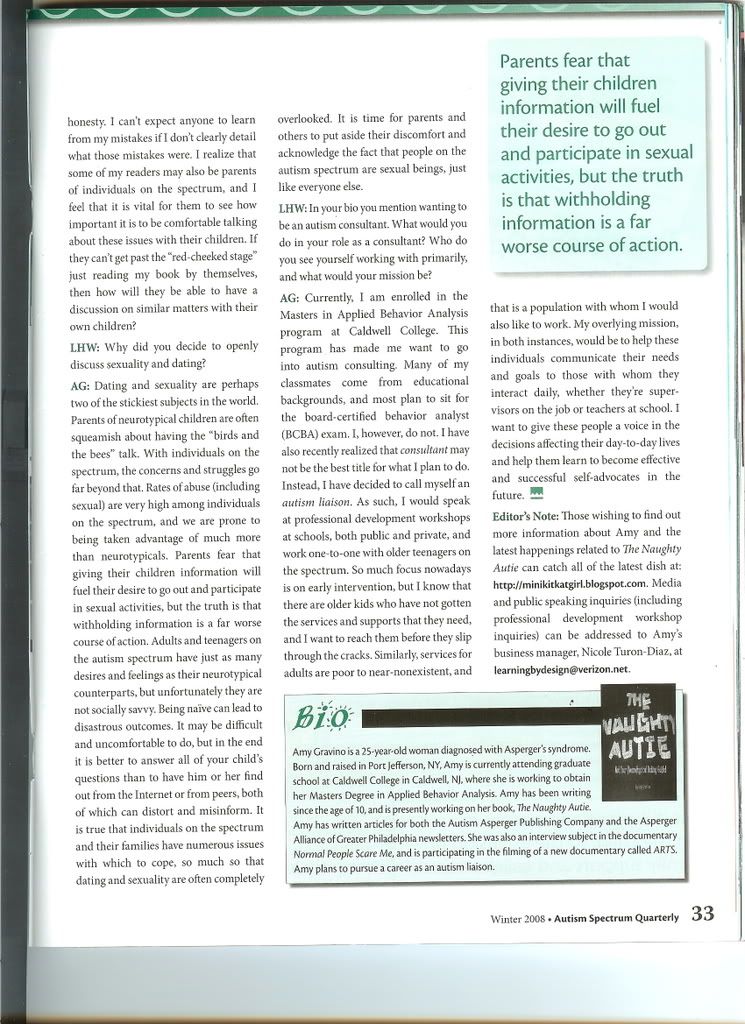
Page One:

Page Two:

Subscribe to:
Posts (Atom)