Showing posts with label current events. Show all posts

Thursday, February 5, 2015

Russian To Conclusions: The Problem with Diagnosing Vladimir Putin with Asperger's Syndrome

This morning, I received a message on Facebook from a friend: "Did you see this?" along with a link to a news story from USA Today. It stated that a study conducted by a Pentagon think tank in 2008 concluded that Russian president Vladimir Putin has Asperger's Syndrome.

Now, after reading the article, as well as numerous posts and comments online in response to it, all I can think is:

The president of Russia has Asperger's Syndrome? You're Putin me on.

There are a number of problems with diagnosing (however roundabout-ly) any world leader with Asperger's Syndrome, never mind one who has as abysmal a human rights track record and history of sociopath-level cruelty and indifference to his own people as Vladimir Putin. 

Right out of the gate, the report on the study says the researchers can't prove that Putin has Asperger's because they were unable to perform a brain scan on him. So it makes you wonder what the aim of running such a story could be, if not to provide something definitive.

What this really is and was is a shot fired. Wars happen not only with guns and bullets, but with words and propaganda. So the shot that was fired in this instance is reminiscent of a Cold War tactic: Discrediting the enemy by saying that he has Asperger's Syndrome.

And therein lies the problem: Whether the researchers intended such or not, Asperger's Syndrome is being used an insult, a reason why Vladimir Putin makes the terrible decisions that he does, and why he should be viewed as an ineffective leader. The equation then turns to this:

Vladimir Putin is evil. 
Vladimir Putin has Asperger's Syndrome.
Asperger's Syndrome is evil
.

It may seem like a far leap to those of us who live in and understand the world of autism and Asperger's Syndrome, but it is not difficult to lead those who are unfamiliar with Asperger's down that path. It is a path already begun with Adam Lanza and the Newtown killings in 2012, and carved out further with every subsequent mass shooting where the perpetrator is immediately described as having Asperger's Syndrome--regardless of whether it is true.

With every unfounded assertion, every assumption and negative media portrayal comes a mountain of discrimination and fear from under which we must repeatedly climb. And when you start to feel as though no one cares if you get out, the weight of that mountain eventually becomes unbearable.

Individuals with Asperger's Syndrome are artists. Writers. Mathematicians. Engineers. We view life through a different lens, and if properly supported and nurtured, can use that vantage to better ourselves, our communities, and the world at large. But if we are continually associated with people like Vladimir Putin--associated with psychopaths, with those who are to be feared, with evil--those opportunities will never come. 

Let us hope that media outlets will consider taking a more responsible tack in reporting stories such as these from now on, because it is not just the United States' relations with Russia or public opinion that is at stake.

The lives and futures of individuals with Asperger's Syndrome are at stake. And we deserve better.

Thursday, November 14, 2013

Recent Public Speaking Appearances and Events!

The last month has brought a wave of several wonderful events in which I am proud to have participated. First, there was Autism New Jersey's annual conference, held on October 17-18th in Atlantic City, NJ, at which I spoke on the Self-Advocate Panel. The panel went on to receive a mention on Autism New Jersey's "Conference Highlights" page. Here I am with the other self-advocate panelists:

Left to right: Kerry Magro, Amy Gravino, John Richardson, and Lindsey Nebeker.
That same weekend, on October 19th, I co-presented a workshop on autism/Asperger's Syndrome and sexuality with Dr. Peter Gerhardt in Richmond, Virginia. The presentation--titled Sexuality & Sexuality Instruction for Individuals with Autism Spectrum Disorders: What Everyone Needs To Know--was co-sponsored by Virginia Commonwealth University and the Autism Society of Central Virginia:

 
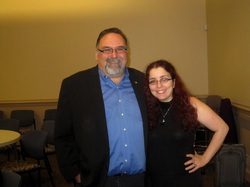
With Dr. Peter Gerhardt.
I want to thank Autism New Jersey and Dr. Gerhardt from the bottom of my heart for inviting me to be a part of these presentations. The response and feedback that I received from members at both presentations was tremendous. The workshop with Dr. Gerhardt was a liberating and thrilling experience in particular, and was the first of what I hope will be many more presentations on the subject of sexuality and autism. It is my goal to become a more recognized authority on the subject, both as a professional speaking from a clinical standpoint and a person on the spectrum coming from a personal perspective.

Want me to come speak at your school or organization? Any and all public speaking or media inquiries should be directed to my business manager, Nicole Turon-Diaz.

Sunday, December 16, 2012

I Won't Go Back: The Sandy Hook Shootings and Asperger's Syndrome

Aurora, Colorado. Clackamas, Oregon. Newtown, Connecticut.

These three places have one thing in common: Each has been the site of a recent mass shooting. While the loss of life at each has been horrific, the massacre in Newtown has struck an especially raw chord, as it took place at Sandy Hook Elementary School. The gunman shot his way into the school, and several teachers, the school principal and psychologist, and--sadly--twenty young children, were left dead in his wake.

Almost immediately, people were scrambling for answers: Who was the shooter? How did he manage to bring several weapons into a school? Why would he commit such a heinous, despicable act? The media has been very quick to provide answers to these questions--though not necessarily the right or responsible ones. 

Within a day of the shooting, at least two major news outlets were speculating that the shooter--who turned the gun on himself--had some form of Asperger's Syndrome. So-called "experts" were trotted out onto programs such as Piers Morgan Tonight, and described Asperger's in the ill-informed fashion so typical of someone who does not know what they are talking about. 

Even with only this, the fear and paranoia have begun to build, and with them, a creeping terror in the pit of my stomach for what this will all ultimately mean for people living on the autism spectrum.

A few nights ago,  Linda Walder Fiddle, of the Daniel Jordan Fiddle Foundation, introduced me at the Hope Swings autism gala, where she was the invited honoree. During her acceptance speech, she referred to me as "one of the premier autism advocates in the country." 

Yet I am sitting here now, trying to make sense of the Connecticut shootings and the media's irresponsibility in characterizing the shooter as having Asperger's Syndrome, and despite Linda's glowing accolades...I am at a loss. As I wade through the jumble of disbelief, sadness, heartache, and a steadily growing sense of fear, there is only one thing that I know for certain:

I won't go back.

I won't go back to believing that I am the only person going through what I am going through.

I won't go back to being that voiceless, frightened girl who thought that she was nothing and would never be anything.

I won't go back to when words like autism and Asperger's Syndrome had no recognition, no meaning...no place in the world. 

Autism and Asperger's Syndrome do have meanings now...and that is what worries me. All too easily, a story on the news translates into frightened parents, children who believe their AS peers are killers, and a stigma that can never be fully shaken. All too easily, children and adults on the spectrum--traditionally far more likely to be victims of violence than perpetrators--can become victims anew, all as the result of a crime committed by a person who in no way represents the overwhelming majority of people living on the autism spectrum.

If I truly am that person that Linda described me as, then my role in this becomes clear: 


I will fight. 

 
I will stand up and speak out for as long as it takes to ensure that no person on the spectrum is unjustly marginalized, disenfranchised, railroaded, or otherwise bullied by a society that wants to demonize us. 

I have to, because there is no other option. There's no reversing course, no shuttering us away in the dank institutions of the past....no undoing the work that so many of us have done.

I won't go back. 

...Will you?

Tuesday, December 7, 2010

On Grief and the Death of Elizabeth Edwards

As I'm sure most folks have heard by now, Elizabeth Edwards--ex-wife of former presidential candidate John Edwards--has died, from terminal cancer. She had only just decided to stop receiving treatment--on the advice of her doctors, who informed her that the cancer had spread to her bones. Not a day later, she was gone.

I can only imagine the sadness her loved ones must be feeling during this time. Everything that she went through, from the cancer diagnosis to her husband's infidelity and fathering an illegitimate child, no doubt took a great toll on her. From every story I have read, it seems she carried herself with dignity, grace, and comportment, despite having to experience all of this under the intense scrutiny of the public eye.

And now, this terrible disease, which went into remission once before, returned to ravage her body further. If nothing else, I am sure her family feels a sense of relief that she has been released from her pain.

But this does not change the fact that she is gone, and that her passing comes at one of the most difficult times of the year: the holidays.

I have some experience in this area, as it were.

In 2001, my one grandpa died four days before Christmas. I was home from my freshman year of college on winter break. My grandma called to tell me, and I felt my heart sink to my knees and my hands grow cold around the receiver as I said goodbye to her. What I did next was one of the hardest things I've ever had to do. I was the only one home, and I called my mother at school, where she was teaching. The secretary in the main office answered and informed me that my mom was in class.

"It's an emergency," I said softly, and told her the news. She did not hesitate to page my mom after that. The air seemed to still when she came on the phone a few minutes later, and then I heard myself tell my mom that her father had died.

My other grandpa died on Thanksgiving in 2003. My parents and I were standing in my aunt's house when my father got a call on his cell phone. He was perfectly calm as he told us, and we left immediately, heading up to his cousin Karim's house, where his side of the family would be.

Nobody spoke as we waited for my great-aunt Lollie and my Aunt Nancy to get there. I remember them walking into the kitchen--my great-aunt in a white sweatshirt with the word "Florida" emblazoned on the front, her straw-like hair freshly dyed and hairsprayed to unprecedented stiffness on top of her head, and the long bags under her eyes, set with wrinkles and stained with dried tears.

She hardly said a word--unheard of, for her--and was followed in by my Aunt Nancy. Her voice was choked as she greeted each of us, the gold Syrian bracelets on her wrist jingling as her hands shook. "He looked like he was just taking a nap!" she sobbed. I cast my eyes to the ground, ignoring the now-fetid smell of the turkey still cooking in the oven.

Last year, my great-uncle Sammy died on Christmas Eve. And though the loss was not as powerful as the previous two, I saw my other cousins swept in a tide of their own sorrow, and I grieved with them for their "giddo" (Arabic word for "grandpa").

I remember the wake. The beautiful stained glass in St. Ann's, a Byzantine Catholic church, and the colorful icons painted across the domed ceiling. I felt the blue carpet beneath my feet, and the cold from the doors opening and closing.

And Kathy, sister of my dad's previously mentioned cousin, Karim. She had been taking care of my great-uncle (her father) for the previous several months. I could see relief in her face, mixed in with the overwhelming grief. I wanted to say something to her, offer a word of comfort, for what little it might have meant. So I took her hand and said:

"I'm sorry. I know right now you're feeling like Christmas will never be the same again. The truth is, it does change your holiday forever--at first, you mourn and grieve, as is natural. But as time goes on, you start to celebrate--to incorporate the things that person stood for into your celebration. Instead of dwelling on what their death took away from the holiday, you remember all that they gave to it, all of the good that came from their presence and how much it meant. How part of them is still there, even after death, and always will be, just as long as you remember."

As I stood in the post office today, attempting to stave off the stress of a long line and only one clerk behind the desk, I thought of this. Of Christmases gone by, Christmases spent with my grandparents. I can still smell my grandmother's cooking in the kitchen, still see their tree festooned with blue-and-yellow ribbons, white twinkling lights, and numerous ornaments.

Christmas is not the same now, not as it was then, nor will it ever be--but it's inside of me. I'll be damned if I can remember a single present I ever got from my grandparents, but that love is something I will never forget. It is my great hope that in time, Kathy and my cousins and the family of Elizabeth Edwards will find their grief lessened, and that good memories will take its place, trading the cold in for the warmth.

Friday, December 3, 2010

In the Event of An Emergency

I recently became aware of a news story out of Towson University, in Maryland. A student there was interning (student teaching) at Thomas Johnson Elementary School in Baltimore City, and she reported witnessing teachers verbally and physically abusing children with autism. The principal of the school immediately attempted to discredit her claims by saying that this student has Asperger's Syndrome and was "mentally deficient and probably lying," and her advisors at Towson questioned her story. The final nail in the coffin was the Dean of Education telling her to stop talking about the incident altogether (Click here to read the full story).

As a student in a Masters degree program in Applied Behavior Analysis, one of my requirements in my first year was to do classroom "observations" at partner schools here in New Jersey.

It was a crisp Fall morning in 2007. I drove down the Garden State Parkway somewhat nervously, having just gotten my license the month before. After signing in at the main office, I made my way through the beige-painted hallway, the walls periodically dotted with the students' brightly-colored artwork.

I sat in a blue chair, the hard plastic pressed against my thighs as I surveyed the self-contained classroom before me. Small wooden cubbies containing coats, knapsacks, and carefully packed lunch boxes lined the wall, and various toys and other objects lay scattered across the carpeted floor. Several pieces of chalk sat idly in a tray beneath the blackboard, and I resisted the urge to pick one up and smell it.

The children made noise, as children so often do, sometimes so shrill and loud that I had to hold my ears. I've never felt particularly at ease around children, but knowing that they were on the spectrum--knowing that I was once them, and in some ways, still am--gave me a small measure of comfort.

Yes, in case you didn't know: I have Asperger's Syndrome.

When I was applying for graduate school, the decision of disclosing the diagnosis was one I did not hesitate on. I stated it outright, both in my written application and during the in-person interview. I believed that it would be an asset, to have a firsthand perspective that I could add to class discussions and use to help my fellow classmates better understand the students with whom they work on a daily basis.

It took a great many years for me to see having Asperger's Syndrome in such a light. To view it as a positive, rather than a negative. And here I was, walking into this completely new environment, unwilling to disguise a diagnosis that had been such an integral part of my being accepted into that environment in the first place.

I was fortunate, yes, where so many others are not. When I imagine being treated as the young woman in this story was treated--her credibility tarnished, her good name dragged through the muck--I am pained beyond the description of words. I am stirred, furious, into an ardor of righteousness, because I know that if I had seen what she had seen, I also would have been moved to report it.

So why should what she says, or what I say, or what anyone else with Asperger's Syndrome say, be so harshly discredited? Indeed, the most laughable part of this entire debacle is the school's principal saying that because of this young woman's condition, she was "probably lying." There is a sad irony to an authority figure whose charges include students on the autism spectrum completely and utterly failing to understand one of the most frequent hallmarks of ASDs, which is the near inability to lie.

People on the autism spectrum are said to be extremely honest, sometimes even brutally so, and that lying is a social event in which they will not and/or cannot engage. For me, it was simply that I never saw any point in lying. I may not have always been so tactful when I was younger, but it was never because I intended to hurt anyone or meant any harm. I have learned how to frame my honesty in a proper context, but never have I diluted it.

I do not believe this young woman would do so, either, and in fact would be more moved to seek justice for the terrible treatment visited upon these students by the very people who are meant to be taking care of them. Because how close did she perhaps come to being one of them? How close did I come? And just as I had no one to speak for me, these children also have no one to speak for them.

Except her.

The school principal and the members of this young woman's department at Towson, by their actions, sought to silence her voice--and, in turn, silence the voices of these children. There can be no defending them, no rationalizing or logic-ing their deeds away.

How can we expect these children to value themselves if the adults around them are so clearly demonstrating that they do not value them? I spent too many years believing I was not a person worth loving, or having as a friend, as a student, a daughter. Too many years believing I was not a person at all, and that vicious trap is what awaits these kids and so many others if things do not begin to change.

This young woman is one of the voices of change, one that I hope will be able to speak up loudly and proudly, rising from the ashes of the two schools' disgraceful actions. I hope she does go on to become a special education teacher and give students with ASDs and other developmental disabilities the support and encouragement they need--the very same support the education department at Towson so astoundingly failed to show her during their gross mishandling of this entire matter.

For the hope of a better future for all: Stop the abuse, stop the cover-up, stop the deliberate spread of misinformation. Let the truth ring out.